
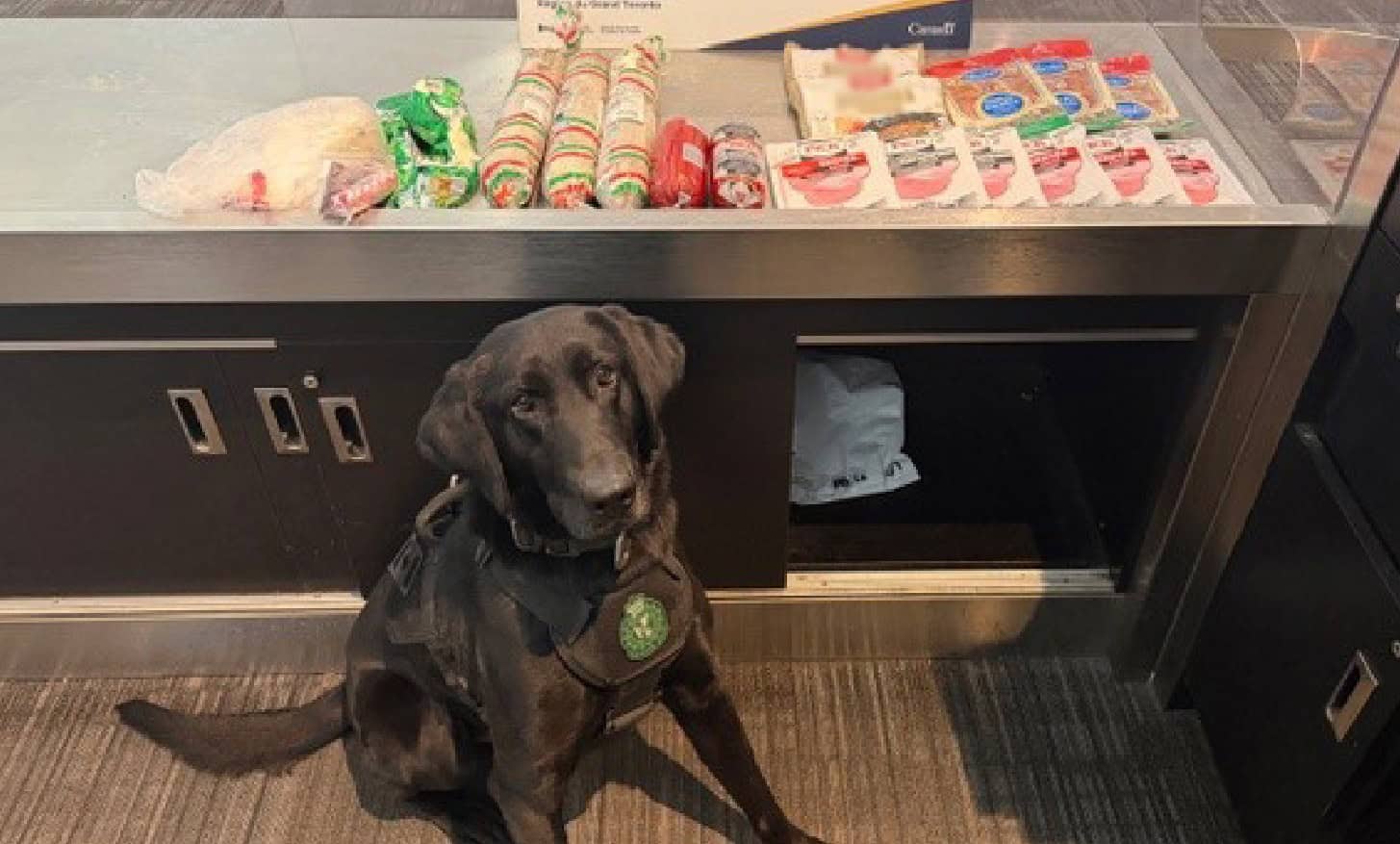
A traveller who’d arrived at Toronto Pearson Airport in Mississauga on a flight from Germany earlier this month was fined after a Canada border services detector dog discovered a five-kilogram stash of undeclared sausages, salami and butter that was packed inside luggage.
A Canada Border Services Agency spokesperson told INsauga.com the undeclared food was discovered by detector dog Jerry as passengers made their way through customs shortly after the April 6 flight touched down at Pearson.
The sausages, salami and butter were seized by authorities and the traveller was fined $650, the CBSA said.
The incident is the third similar seizure of meat involving detector dogs made at Pearson and publicized by the CBSA in recent weeks.
40 kg stash of beef and chicken
It was reported last week that CBSA dog Moby had recently tracked down a 40 kg load of undeclared beef and chicken inside a traveller’s luggage. The passenger, who’d arrived on a flight from Nigeria, was also fined in that case, the CBSA said.
On March 8, detector dog Dharla discovered 22.5 kilograms of raw duck, pigeon, chicken and rabbit that was packed inside the luggage of a traveller who’d arrived at Pearson from Egypt.
In that case, though, the food products had been “properly declared, so no enforcement actions were taken against the traveller,” the border services agency said earlier.
However, the raw meat and poultry were not allowed into the country as Canadian Food Inspection Agency regulations were violated, the CBSA said.
#DetectorDog Jerry intercepted over 5 kg of undeclared sausage, salami, and butter from a traveller arriving in the #GTA from Germany. The traveller was fined CA$650 and the goods were seized. #BeAwareAndDeclare: https://t.co/5e83PT86zz pic.twitter.com/qaLuVR9Tcc
— Canada Border Services Agency (@CanBorder) April 16, 2026
The CBSA spokesperson told INsauga.com the agency “continuously tries to raise awareness regarding the need to declare items when entering Canada.”
All travellers are subject to CBSA examinations and “are required to make accurate and truthful declarations when entering Canada,” the spokesperson continued. “Highlighting seizures done by CBSA detector dogs is another effort to raise awareness and remind travellers of this.”
Jerry, a five-year-old Labrador who’s been working at the CBSA since April 2023, works at Canada’s biggest and busiest airport along with Moby, Dharla and an unspecified number of other well-trained detector dogs, the agency spokesperson said.
The border services agency added it cannot disclose the number of detector dogs on duty at any of Canada’s airports at a given time.
In the latest seizure of undeclared goods, Jerry used his search talents to sniff out the food “while conducting proactive searches in the baggage hall,” the CBSA told INsauga.com, adding the canine law enforcement officers “are trained to detect and sit beside the source of the odour to indicate possible prohibited items to their handler.”
The CBSA’s detector dogs “are trained specifically to detect a wide range of contraband such as drugs, guns, money, and food, plant and animal products,” the spokesperson said.
Previously, according to an online description of the detector dog program, all dogs were trained to scratch, dig, bite and bark at the source of a contraband odour.
“Today, the primary method of training is for dogs to give a subtle signal to their handler when detecting contraband,” the CBSA said.
#DetectorDog Moby intercepted over 40 kg of undeclared beef and chicken in the #GTA, found in a traveller's luggage arriving from Nigeria. The food products were seized and the traveller was fined. Be aware and declare: https://t.co/lA5RHWJEFu pic.twitter.com/JuHk1MgkqQ
— Canada Border Services Agency (@CanBorder) April 9, 2026
The agency added its canine officers “are highly trained and are evaluated regularly throughout their careers with the Canada Border Services Agency.”
The dogs and their officers play an important role in the detection of prohibited and regulated goods entering Canada, according to the agency, by:
- Increasing opportunities to intercept drugs, guns, money, and food, plant and animal products.
- Discouraging smugglers, while educating Canadians about the CBSA’s innovative enforcement approaches.
- Helping border services officers simplify searches.
- Reducing screening times for passengers, luggage and commercial shipments.
“Dog teams also help other law enforcement agencies with search warrants for drugs, guns and money,” the CBSA said, adding it uses all types of dog breeds, including Labrador Retrievers and Beagles, to detect contraband.
Typically, according to the agency, detector dogs:
- Are 11 to 16 months old when training begins.
- Live with their handlers.
- Travel in air-conditioned vehicles.
- Work for eight to 10 years before retiring and living with their handlers or in a home arranged by their handlers.
#DetectorDog Dharla sniffed out over 22 kg of raw duck, pigeon, chicken, and rabbit in the #GTA, found in a traveller's luggage arriving from Egypt. Learn more about declaring food, plant, and animal products: https://t.co/JzIurTTNSc pic.twitter.com/YVholl7gVY
— Canada Border Services Agency (@CanBorder) March 16, 2026
Detector dog teams receive “intensive training” at the CBSA College in Rigaud, Québec before being deployed to airports and other locations across the country.
The CBSA noted it also trains dogs from Correctional Service Canada and many other domestic and international policing agencies worldwide.
“Handlers learn to care for and train their dogs at the CBSA College where the animals learn to understand their new working environment,” the agency said. “The CBSA maintains very high standards for its dogs. Only one of 10 dogs evaluated is accepted.”
Once dogs go on duty, an assessor evaluates every dog team annually to ensure they’re working effectively, the CBSA said.
Formerly known as Canada Customs, the agency began using detector dogs in “to help frontline officers with a more effective method of detecting drugs and firearms.”
In , the Detector Dog Service expanded to include food, plant and animal detector dog teams from the Canadian Food Inspection Agency.
What to know when bringing food into Canada
The Canadian government reminds travellers they are required by law to declare all food, plant and animal products being brought into the country.
For instance, travellers must declare:
- Live animals and animal products such as cooked or raw meats, hides, skins, trophies, milk, fat, butter, cheese, eggs, fish and seafood.
- Plant products such as fruits, vegetables, seeds, nuts, trees, houseplants, wood (and wood products such as furniture, carvings, bark), firewood, roots, vines, herbs, flowers, insects, bulbs and soil.
CBSA officials say failure to declare any of these products or to provide required permits/certificates can lead to:
- Detention of the products
- A penalty up to $1,300
- Prosecution
“Inadmissible goods may be confiscated and disposed of, or ordered removed from Canada,” the border services agency said in an online update to travellers. “Travellers may also be held responsible for any costs related to the disposal, quarantine, treatment or removal of these items from Canada.”
The CBSA noted many travellers fail to declare items such as:
- Processed or canned foods
- Homemade food
- Handmade crafts, such as wooden items
- Firewood
- Cooked or cured meats
- Soil
- Bait for recreational fishing
- Plants used for homeopathic or medicinal purposes
- Milk products, such as butter, yogurt, kefir
- Fruits and vegetables
“Travellers may not realize the hazards associated with food, plant and animal products. These products may carry invasive species and diseases and may cause risks to Canada’s food supply, economy, environment and our health.”
INsauga's Editorial Standards and PoliciesPollView All
WIN A $100 GIFT CARD
Subscribe to INsauga’s daily email newsletter for a chance to win a $100 Amazon gift card.