
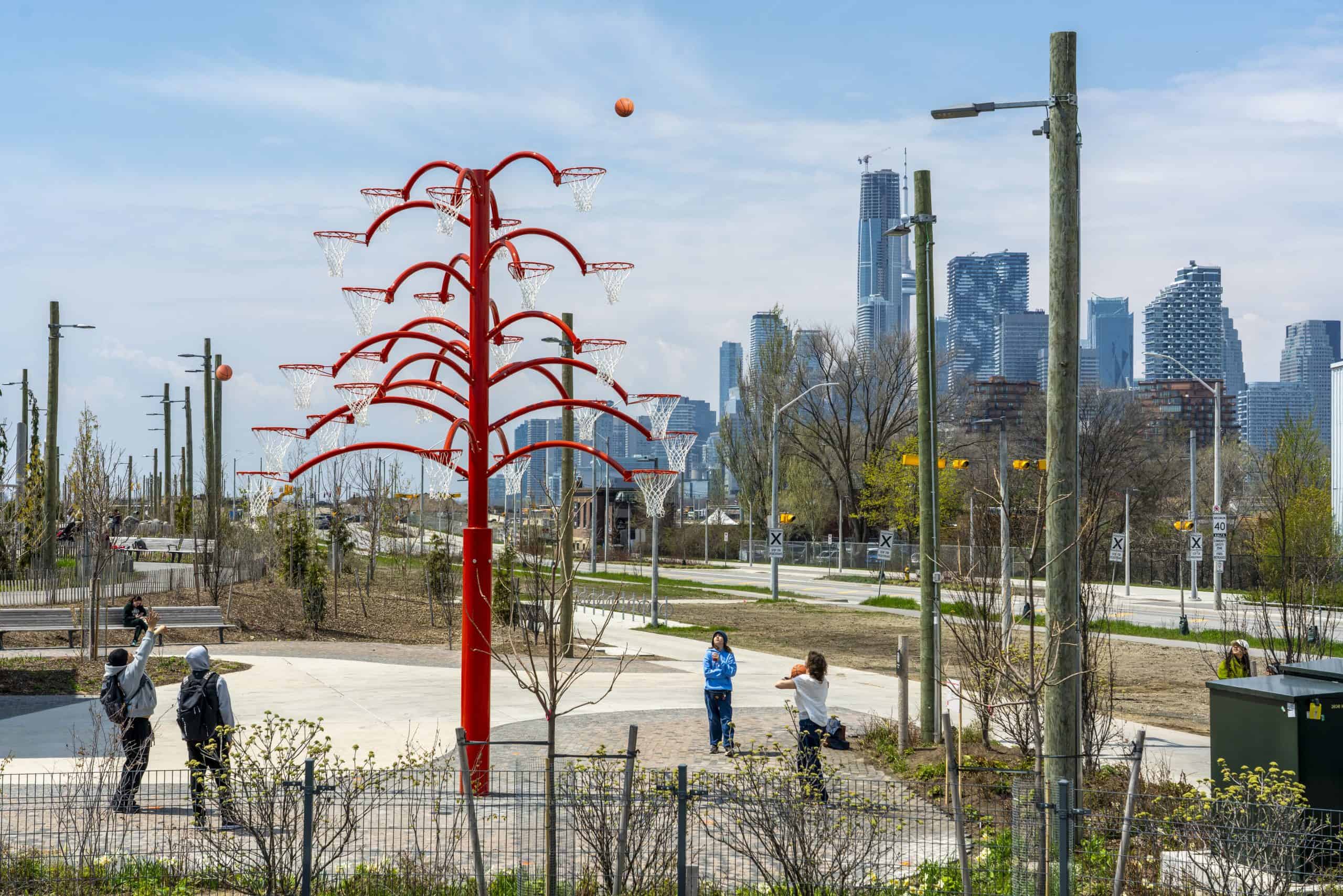
A basketball tree isn’t something you see every day. Nor is a pewter-hued table that’s fixed to the ground, piled high with rock-solid (and affixed) eggs, cutlery and stuffed animals.
Now, these are part of a brand-new open-air gallery that debuted this month.
People who live in Toronto might, fatigued from seemingly endless construction delays on major infrastructure projects, be under the impression that the brass at all levels of government can dream big but struggle to nail the landing.
One project, however (albeit one with many phases yet to go), is bucking the trend and pushing forward, showing that ambitious visions can be realized–and rivers literally can be moved–with diligence, effort, time and, most importantly, an appreciation for the city’s place in a world that yearns for beautiful places to experience fun, connection, nature and culture.
Last week, people were invited to glimpse the first pieces that will make up the Lassonde Art Trail, a one-of-a-kind public (and free) art trail featuring permanent and temporary installations by acclaimed local and international artists.
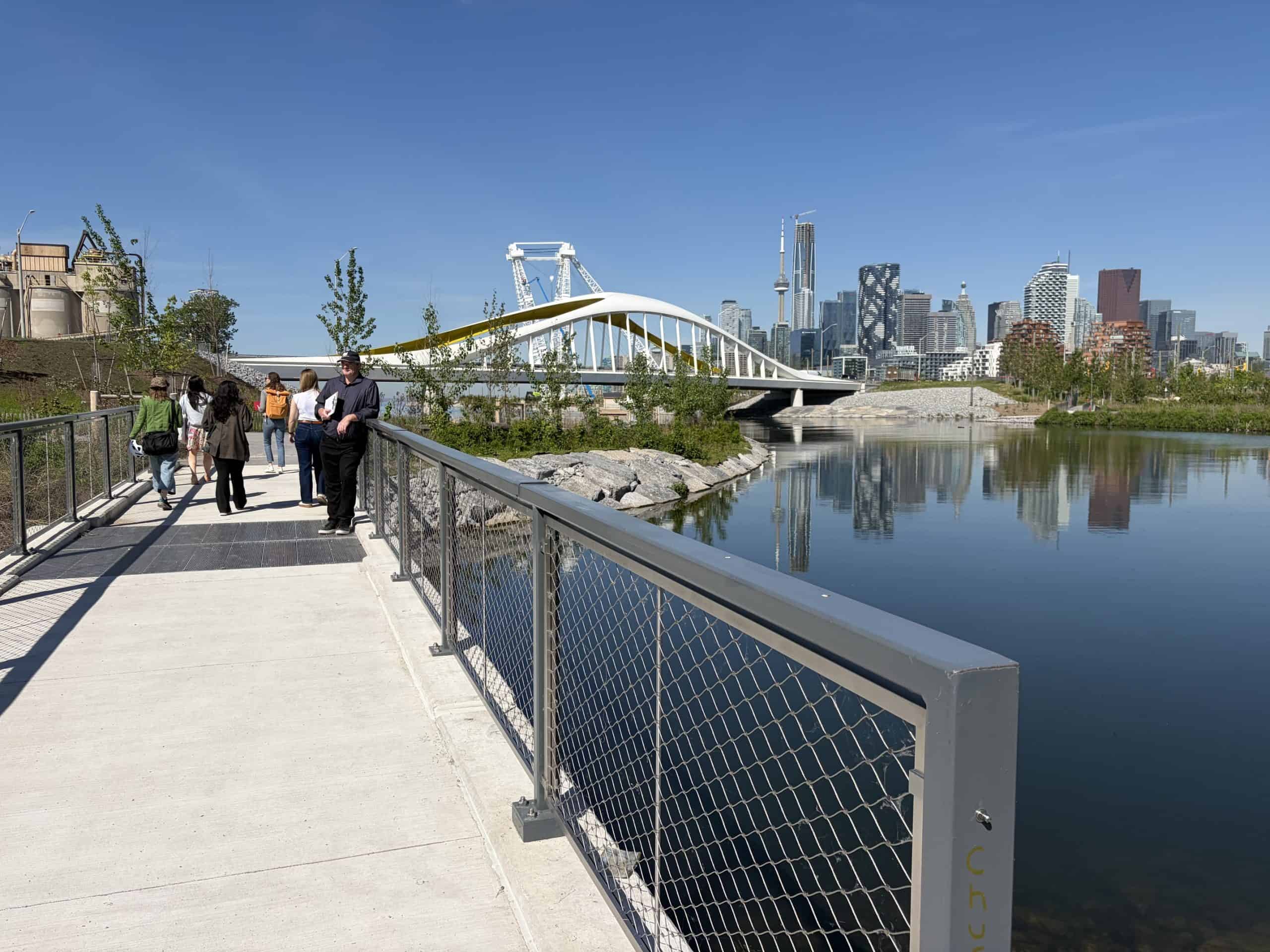
The LAT, which will span over four kilometres, will feature 15 interconnected public art sites throughout Biidaasige Park. The park, the first part of which opened last year, is part of a significant $1.4 billion infrastructure project spearheaded by Waterfront Toronto, and the first public space to open on Ookwemin Minising (formerly known as Villiers Island), a new island in the Port Lands.
Located where the Don River meets the lake, the new island was created by ongoing flood-protection and river-restoration projects in the area. Once complete, the 98-acre island will boast 50 acres of parks and 80 acres of parks and green space (including the river).
When the LAT reaches completion, it will include renowned Canadian artist Kent Monkman’s first permanent public sculpture, Monira Al Qadiri’s monumental work First Sun (direct from NYC in partnership with Public Art Fund), and a new sculpture by internationally acclaimed artist Alicja Kwade (which will debut in 2027).
While the first pieces were unveiled this month, the project has been in the works for several years.
“We had very much been thinking about how we could bring amazing and, let’s just say, world-class art or a really exciting art layer to that [space], Chloë Catán, executive director at the LAT, told INsauga.com late last year.
The LAT is the newest part of Biidaasige Park, located at the intersection of Cherry Street and Commissioner’s Street. The first portion of the park, which features a massive owl, two ziplines, a raccoon climbing structure, a Badlands-style playground (complete with multiple water features) and brand-new hiking and biking trails, opened to significant fanfare in 2025.
Last week, Catán and November Paynter, the artistic director and chief curator of the LAT, along with other Waterfront Toronto representatives, conducted a media tour of the trail’s eastern section, showcasing the first pieces installed in the park.
Catán told reporters that for her and Chris Glaisek, chief planning and design officer at Waterfront Toronto, this project is an extension of their experience integrating art into various Toronto neighbourhoods. Catán said the project was made possible by a sizeable monetary contribution from philanthropist Pierre Lassonde, who was invited to view progress on the site and committed a $25 million gift to realize Waterfront Toronto’s vision.
The funding includes $10 million for two permanent destination artworks that will be gifted to the city’s Public Art and Monuments Collection and $15 million to sustain programming over the long term.
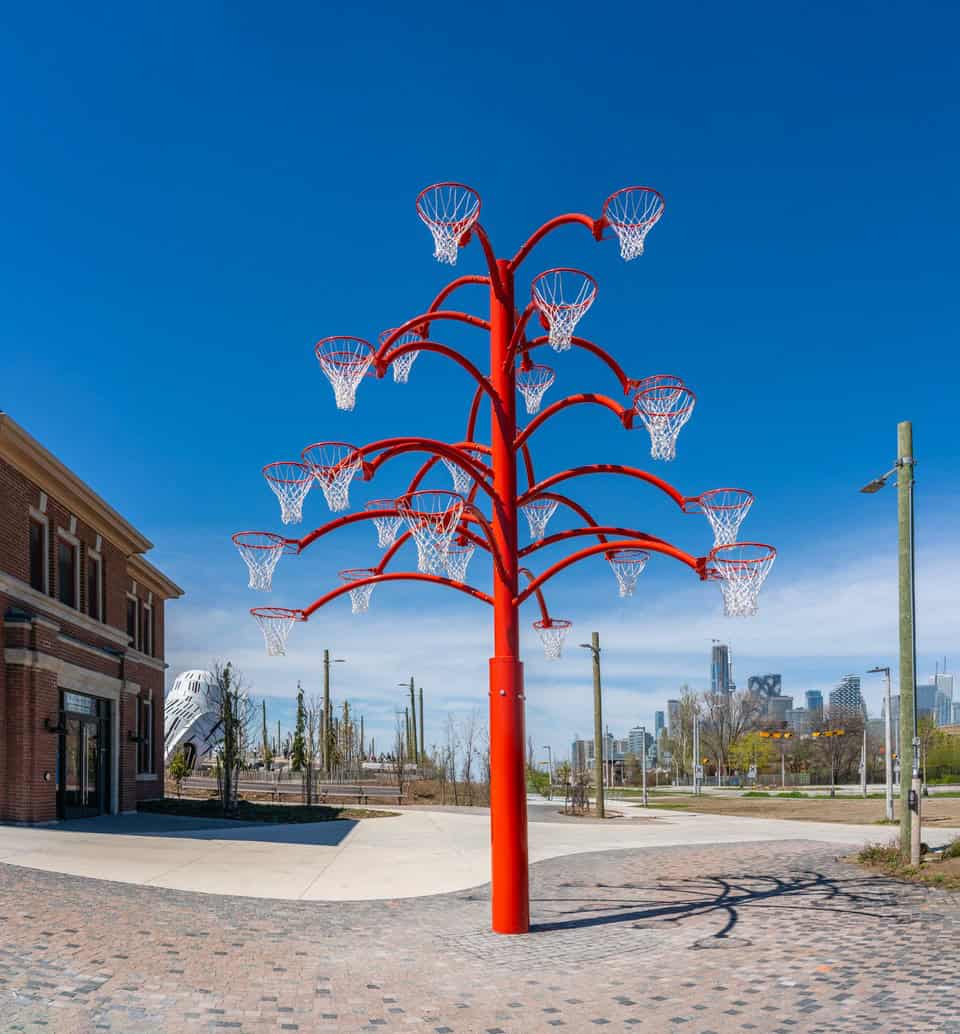
Orange Functional
“We met Pierre Lassonde, who was incredibly inspired not just by the big picture of, you know, kind of building a new river and an island, but also about this really ambitious idea of having a free public art trail,” she told reporters, adding that the new island marks one of the biggest civil engineering projects in North America.
“What makes this really unique is that it’s not only going to attract those that love the environment and the ecology and the trails, but it’s going to attract those that love art,” Glaisek told reporters.
“And then those that may not know a lot about art are going to stumble upon incredible pieces and will even engage with the artwork. So it’s really exciting.”
The first piece is Orange Functional, a 2022 installation by Alexandre Arrechea, an acclaimed visual artist from Cuba who gained prominence as a founding member of the Cuban collective Los Carpinteros. Located right near the Old Fire Hall at one of the main entrances to the park, the piece looks, from afar, like a solid orange metal tree. At the end of the branches, you’ll find basketball nets–and yes, you can throw a ball into them.
The piece, a temporary installation that offers visitors something whimsical right out of the gate, was first conceived in the early aughts and popularized many years later by a cheeky social media post from former NBA superstar Shaquille O’Neal.
“I wasn’t able to really produce something like [Orange Functional] until 2010. I was invited by the Bronx Museum in New York to bring a project, and I showed them this idea I had for an orange tree. They loved it, and the piece was produced and installed [there],” Arrechea tells INsauga.com.
Initially, the sculpture wasn’t interactive and was surrounded by basketballs attached to the ground, simulating “fruits falling from a tree.”
“It was like being in front of an object that simulates the idea of participation, but you cannot play with it. It’s like the rules are completely broken in that regard,” he explains.
Arrechea says the piece took on a new life when O’Neal took a picture of himself in front of the work and joked that he built the sculpture out of the basketball hoops that he broke over the course of his career.
“I totally understand it was a joke from his side, but at my expense. So the piece started to navigate on social media and sports channels under his authorship,” Arrechea says, adding that once he and his team were able to attach his name to the work, he was able to capitalize on the newfound attention and adapt the work to reflect the climate of a post-COVID world where people craved interaction and play.
Arrechea says the playfulness of Biidaasige Park, which features several eye-catching climbing structures right off the roadway, made the reimagined Orange Functional a natural fit for the LAT.
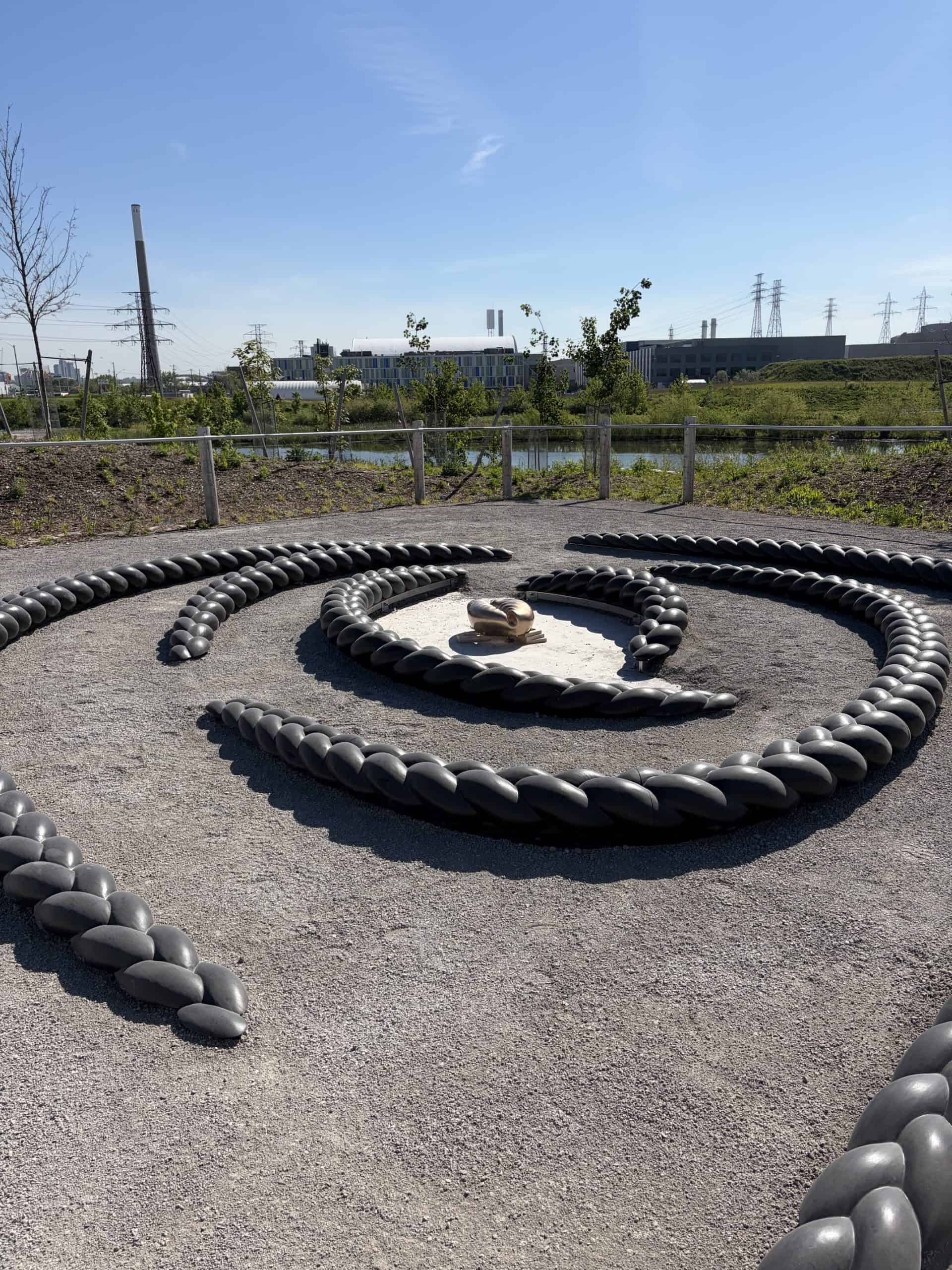
Crown Act
“November and Chloe were really certain about the location of the piece. Against the [fire hall], it kind of becomes the patio of the building. For me, it’s important, this aspect of building community and how to build community through art. I think this is the first time that this particular work that I’ve been developing over the last 10 years really finds that location that brings all those elements that I’ve been pursuing for so many years,” he says.
Arrechea, who splits his time between Miami and Madrid, also says that Paynter and Catán helped him find local fabricators to bring the project to life domestically.
“They introduced me to these fabulous fabricators. We started exchanging information, and I really trusted them, and we initiated the project. It’s been a joy to work with them and to finally have the piece installed,” he says.
Paynter told reporters the playful nature of Orange Functional acts as a perfect introduction to both the park and the trail.
“The idea here was really to think about participation, play, you know, making sure that people who are coming to the park that may never have encountered contemporary art before see something they recognize that’s joyful and playful, and they are inspired to then progress and see the rest of the art trail,” she said.
Arrechea’s piece is not the only one marking the eastern portion of the LAT. After viewing Orange Functional, Paynter and Catán took reporters to view Crown Act. Conceived in 2026 by Nigerian-Canadian artist Oluseye, the maze-like piece features large, braid-like sculptures wrapped around a metallic cowrie shell.
The piece draws inspiration from Ontario’s connection to the Underground Railroad. The LAT also said the sculpture references escape maps sometimes concealed in women’s braided hair.
The piece is one of many that speak to the diversity of the Canadian experience and how the LAT aims to showcase talent from everywhere, using materials that pay homage to the location.
“ There are artists from around the world, different materialities responding to different thematics. So it’s a really diverse selection,” Paynter said.
Homing
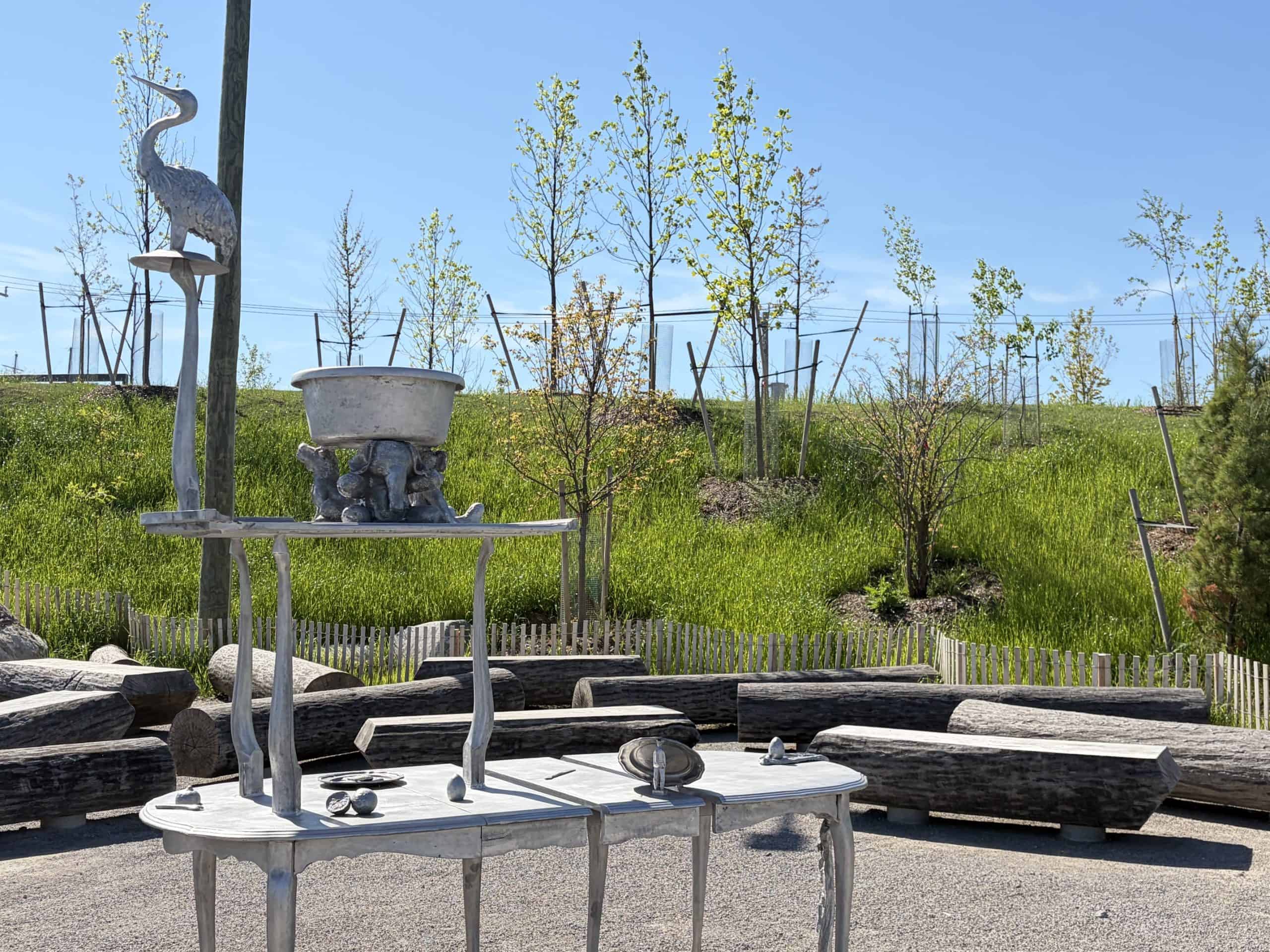
Another standout piece is Homing by Nadia Belerique and Tony Romano, which features a pewter-coloured dining room table piled with plates, cups, eggs, stuffed animals, a basin and a large bird. The sculpture, eminently climbable (though signage advises against it), fuses indoor domesticity with outdoor fun. After Homing, visitors can view the understated Roman Standard by Tracey Emin and the loud Delicate Matter by Kara Hamilton, which features two beautifully detailed sculptures seemingly in conversation with one another, speaking through bits of brass instruments.
“ So essentially the two busts are like two heads speaking to each other, having this kind of reciprocal conversation,” Paynter explained to reporters.
Other pieces on display include Stories of Relics by Ryan Gander, which consist of fluorescent metal boxes fused to rocks and Trajet by Caroline Monnet and Dean Baldwin Lew, a permanent fixture designed to acknowledge footprints made by Indigenous people that were uncovered in blue clay on the floor of Lake Ontario in 1908.
While more sculptures and pieces are slated to arrive when the western part of the LAT opens, Waterfront Toronto’s Glaisek says the organization knew it wanted to focus on temporary pieces early on.
“ So as we were doing the public art master planning for Ookwemin Minising, we thought public art is becoming more and more focused around temporary pieces, less and less on permanent,” he tells INsauga.com, adding that the project was influenced by public art at the Doris Freedman Plaza in New York City.
“You see that in lots of cities where these cool art installations will come up or art pieces will get put up for a couple of years, they’ll come down, and another piece will come, and it enables the art to stay more current, more fresh in some ways and provides more outlet for more artistic expression.” 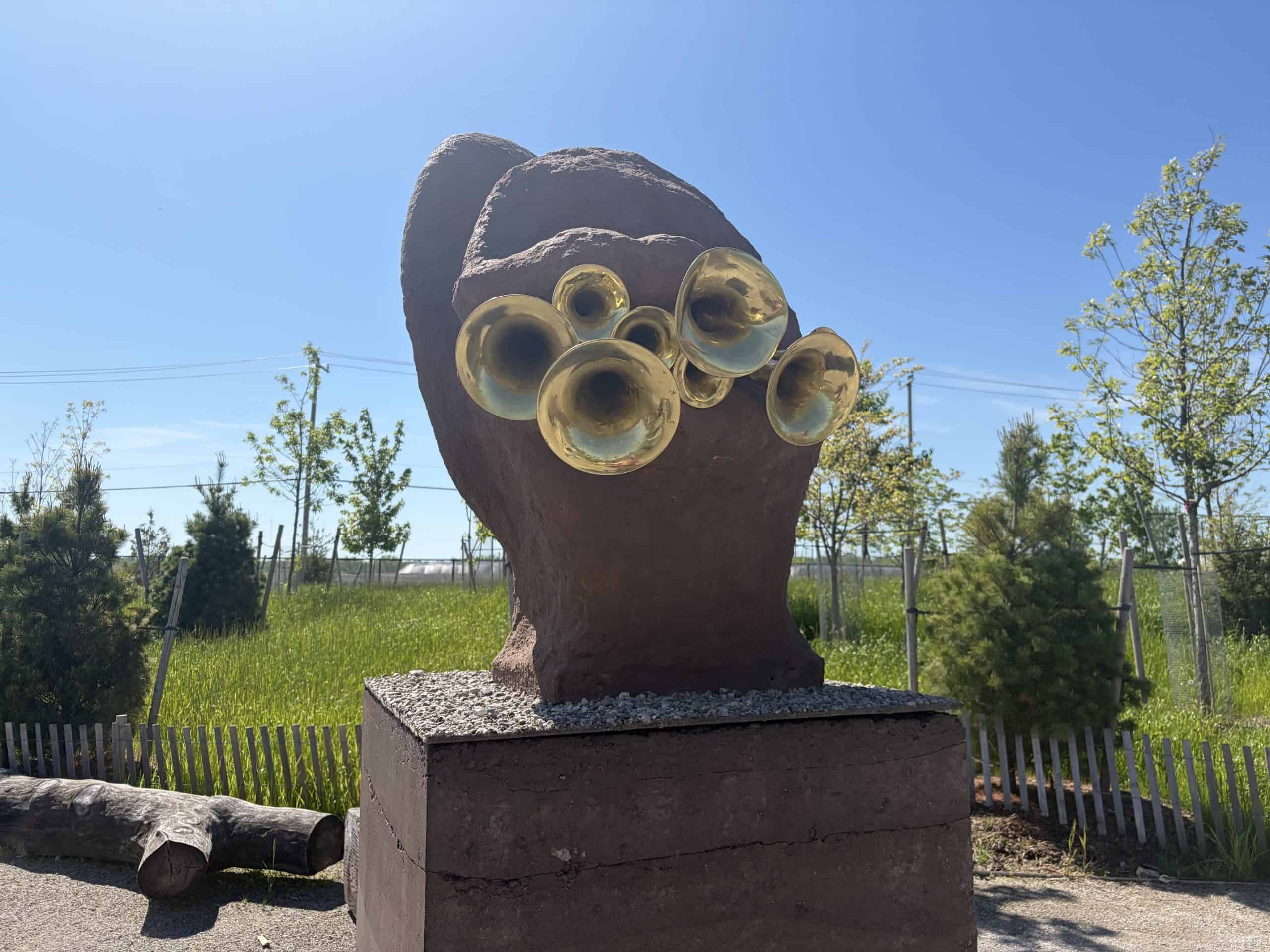
Delicate Matter
Glaisek says that during the visioning for the new island, they wondered how they could bring a thriving temporary art scene not just to the property but to the city as a whole.
“It’s very hard to get permits to do temporary art. And so, even though there are a lot of artistic people in this city, there hasn’t been an easy way for most of them to get their work out, so as we were designing the park, we said, let’s design the park as a platform for temporary art.”
Next month, works by Alexa Kumiko Hatanaka, Lisa Hirmer, Virginia Overton and Hank Willis Thomas will debut on the trail and in the fall, the LAT will welcome pieces by Al Qadiri and Monkman.
Kwade’s piece will be on view in 2027, along with Artemisa by Joana Vasconcelos.
The second portion of Biidaasige Park is anticipated to open in July.
INsauga's Editorial Standards and PoliciesPollView All
WIN A $100 GIFT CARD
Subscribe to INsauga’s daily email newsletter for a chance to win a $100 Amazon gift card.