

While not every company can erect a multi-storey screen in a sprawling, open atrium that looks more like a hotel than an office, provide daily (or weekly) decadent restaurant meals or open a unique cafe that provides meaningful employment to some of the city’s most overlooked residents, those that can infuse their workspaces with exclusive perks are doing so–and they say the feedback has been more than positive.
The office
“The feedback is that people genuinely want to be in the office,” Stephanie Panyan, principal, interior design at the Toronto-based B+H Architects, tells INsauga.com.
Panyan and her team recently took on the transformation of the flagship workplace of insurance company Jones DesLauriers Independent Insurance Brokerage, helping the company move its 320 Bay Street office into “a new era.” The era is one in which some employers, whose workforce has grown accustomed to partial or fully remote work over the past six years, need to go the extra mile to entice people back to their desks.
In the case of JDIMI, the lighthouse–the beacon that draws people to shore–was an integral part of the design overhaul.
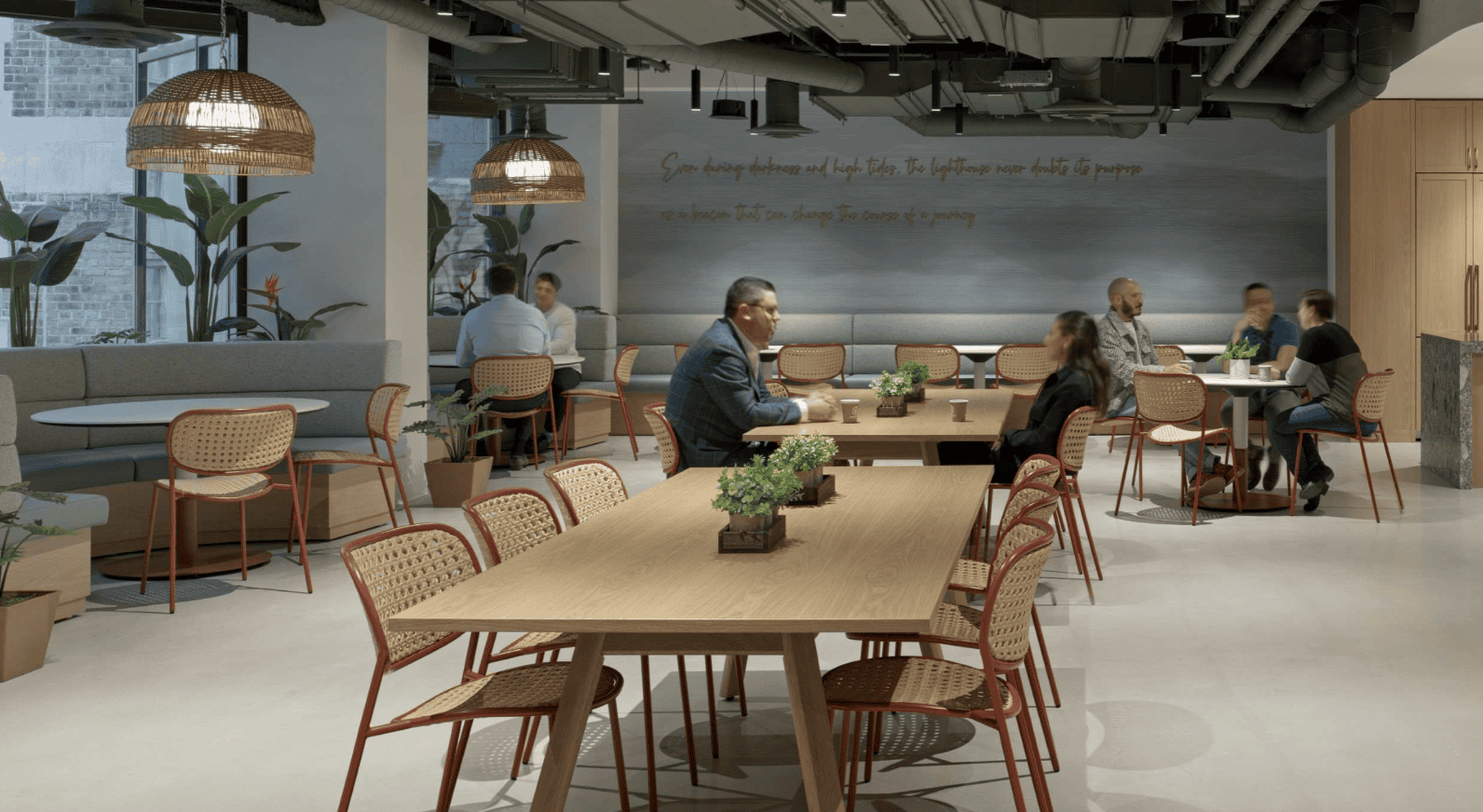
Rendering from B+H
“Clients are thinking of meaningful ways to bring people back to the office,” Panyan says, adding that gourmet beverages (more on those later) are part of some companies’ investment in homier, more hospitality-driven spaces.
“Specifically for JDIMI, when we first did our visioning sessions with the President & CEO, Scott Irwin, he was clear he wanted the office to feel like a beacon. He used the lighthouse as an analogy, a place that would draw people back to work. And we thought, ‘What are the ways that we can do that within the office?’”
Going the extra mile makes sense at a time when the numbers suggest many remote workers are hesitant to return to the office. As far as the public sector goes, federal unions have fought the government’s back-to-office directives and some have filed unfair labour practice complaints.
Nathan Prier, president of the Canadian Association of Professional Employees, delivered remarks at a demonstration in front of the Prime Minister’s Office on July 6 to denounce the new rules, calling the federal government’s return-to-office order a “handout” to major banks to protect their roughly $10 billion worth of commercial real estate office exposure.
But while there has been resistance to returning to the office after years of remote work, data indicate that the office is far from dead, and companies are happy to entice workers back with modern perks initially popularized by tech giants such as Google and Meta.
“There’s a stigma out there that the office is dead, but it’s the exact opposite,” Reuben Barkin, director of operations at commercial construction and renovation company BUILD IT, told INsauga.com earlier this year.
“The office isn’t dead, it’s being rebuilt with purpose. We’re not building offices the way we did prior to 2019. Companies are investing in environments that justify the commute.”
Last spring, Barkin said BUILD IT completed the new Mississauga office for international toy company ZURU. Renovated over a six-month period, the reimagined office offers workers an open-concept space with booths, couches, communal tables, stylish hanging light fixtures, a kitchen with a sizeable island, houseplants, product showrooms designed to resemble sections of a chic department store, glass-walled boardrooms, and private workspaces.
At the time, Barkin said the demand for office space is rebounding, and the data bears this out.
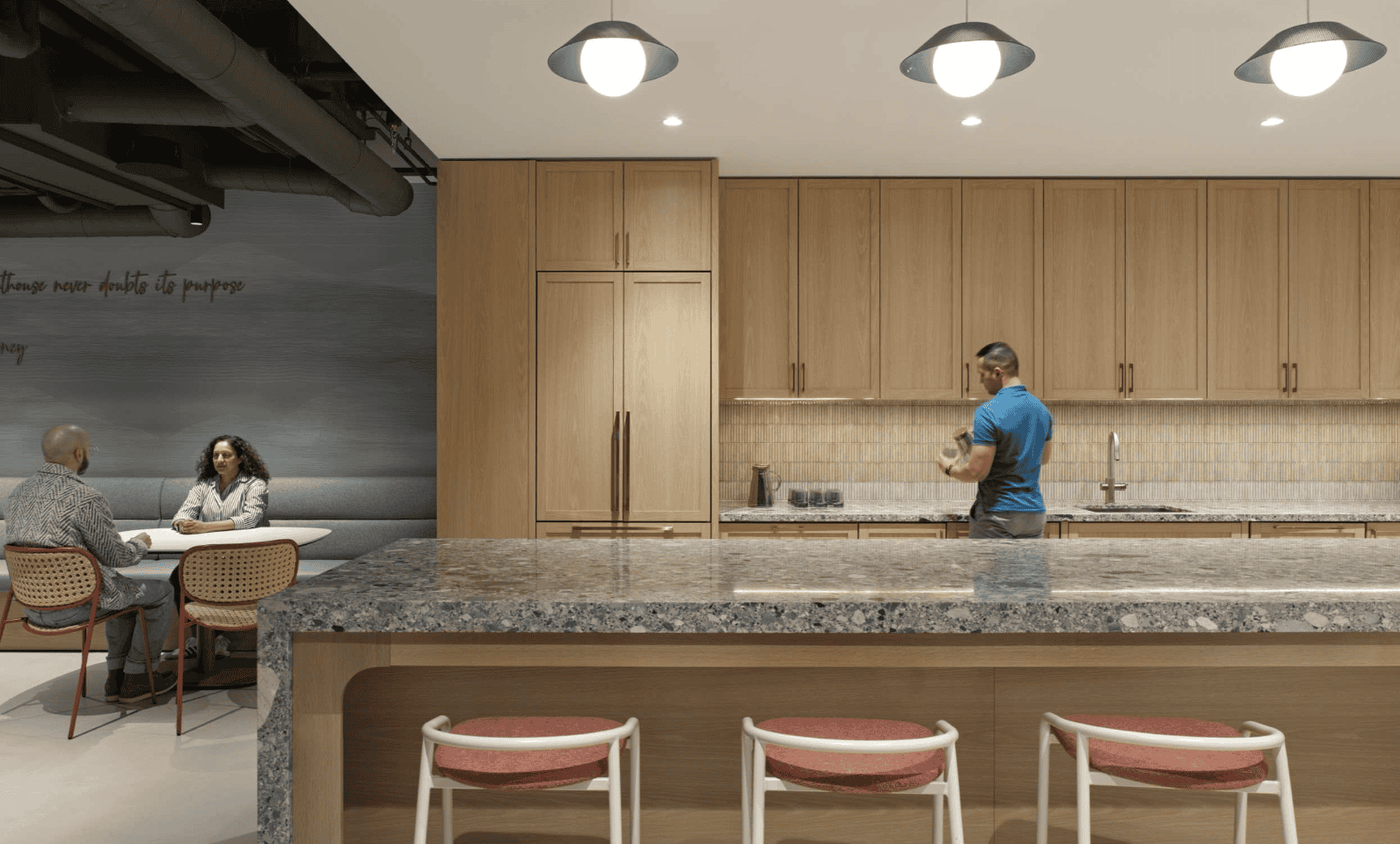
Rendering from B+H
A recent Colliers report indicates that in the last quarter of 2025, the vacancy rate of top-tier office space around Union Station in Toronto dropped to 3.2 per cent from 5.8 per cent over a two-year period, with rents for such in-demand properties rising 21 per cent from 2020 to hit about $50 to $55 per square foot.
The report notes that the vacancy rate in the GTA fell to 11.8 per cent from 12.9 per cent, with the west end of the GTA at 10.8 per cent. With no major towers planned until 2031, rents for top-tier office space (which also climbed four per cent year-over-year) are expected to continue to rise.
With work culture shifting and more people in the public and private sector being asked to return to in-person facilities, some companies are putting comfort and connection front and centre.
Panyan says that her team transformed JDIMI’s roughly 20,000-square-foot office by creating collapsible spaces and even some decompression areas to encourage people to embrace in-person work.
Beyond using natural textures, soothing colour palettes, and an earthy colour scheme, B+H and JDIMI worked to include a gourmet cafe that offers workers more than typical drip coffee and creates jobs for some of the city’s more vulnerable residents.
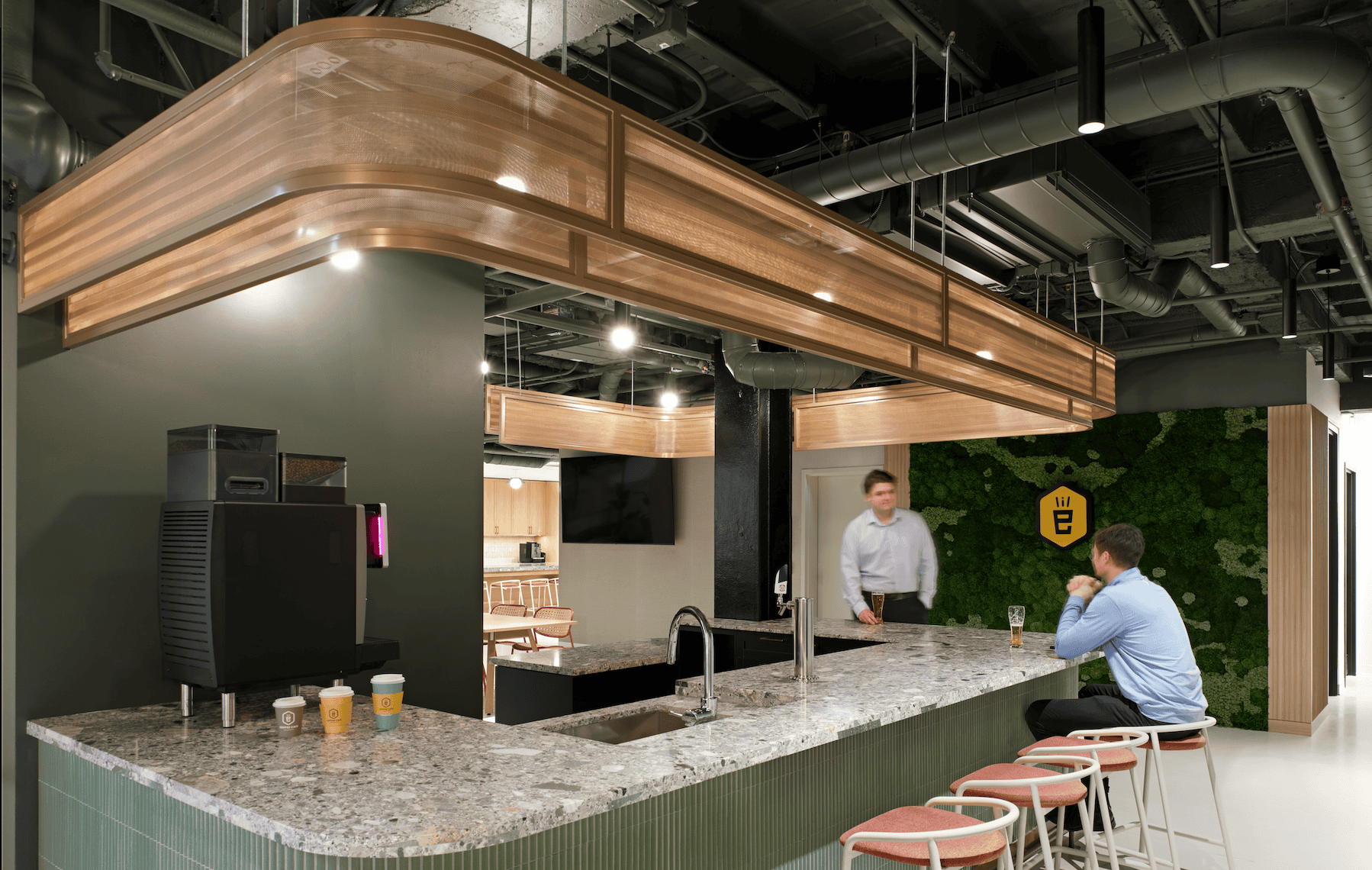
Rendering of cafe, courtesy of B+H
The satellite location for Lil E Coffee Café is a not-for-profit enterprise that employs people with intellectual and developmental disabilities and is designed to be “a grounding element of the office.”
“The Lil E Coffee café space was a large square footage of the floor, and it was important to the staff and the leadership at JDIMI to give staff a space to step away from their desks [and] into this cafe area by bringing their laptops and having more casual and informal meetings with their colleagues,” Panyan says.
“Every time I’ve been there on the floor, it’s been fantastic because there’s always something going on.”
And unlike other Lil E cafes in Canada, the JDIMI location is exclusive to employees. Panyan says that during the typical workweek, Lil E will serve up to 80 people in the office.
“It’s really helping foster that culture that Scott and Imran Pira, Managing Partner and Head of Complex Risk, wanted to create. Where people are engaging with each other and, you know, really connecting with the firm. It’s just not a superficial perk. It’s really a way to bring people together and at the same time, give them a fantastic beverage,” she says.
The Hospitality Experience
Another company that has gone all-in on the wow factor is GWL Realty Advisors, a Canadian real estate advisory firm that recently unveiled extensive renovations to the lobby at Berczy Square, a centrally located office building that stands at Yonge and Front in the downtown core, just steps away from the beloved Berczy Park dog fountain, tons of restaurants and the historic St. Lawrence Market.
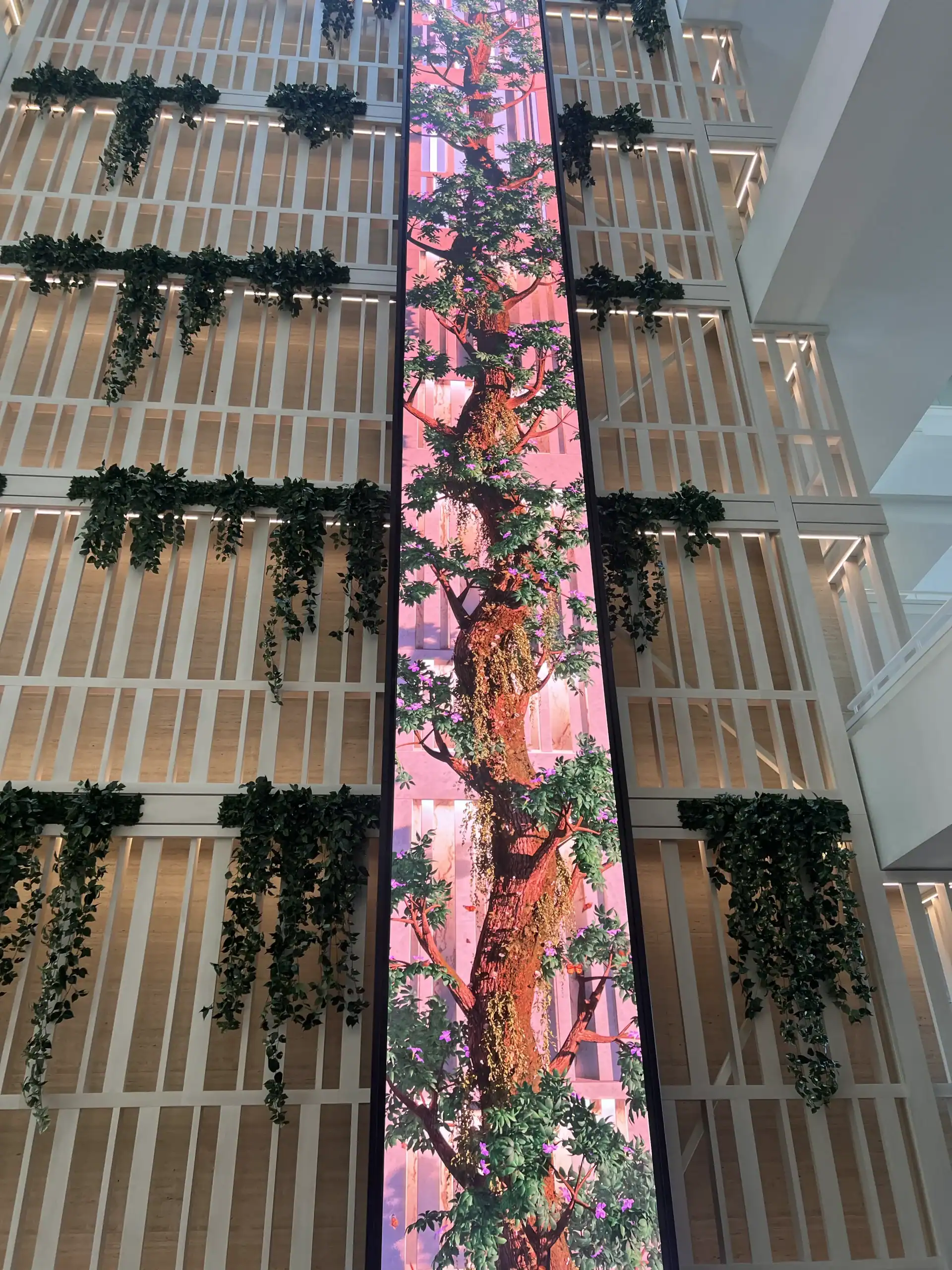
To welcome workers back to the office, the building, which is home to multiple commercial tenants and can accommodate about 3,000 people when at capacity, GWLRA decided to highlight the rare atrium-style lobby by constructing a 90-foot-tall, six-foot-wide screen that runs the full spine of the building and features original digital art by Montreal-based creative multimedia studio Gentilhomme.
The studio has created large-format immersive art for the Burj Khalifa in Dubai, George Bush Intercontinental Airport in Houston and Cirque du Soleil.
The huge investment has reportedly paid off.
“We’ve owned this building since the early ’90s and we want to own it for a long time,” Devan Sloan, vice president, asset management and leasing at GWLRA, tells INsauga.com.
“So it was the perfect time to reinvest and to spend the money to attract and retain tenants, and it’s worked. Before we even opened the lobby, we were 96 per cent leased.”
Beyond the sky-high screen, the lobby boasts other hospitality-inspired features, including an eye-catching vapour-based firepit with orange-hued steam emerging from perfectly round black rocks, restaurant-style seating and cascading plants.
The decidedly zen overhaul was spearheaded by Alison McNeil of architecture firm DIALOG, who also redesigned the Four Seasons Hotel Toronto lobby and bar. The rejuvenated lobby also includes tree-like columns at the Yonge Street entrance, a reflecting pool, and a trellis that preserves the original Travertine wall. The office is also home to a private fitness facility, showers and lockers for commuters who bike and walk, five outdoor patios, two coffee shops, and grab-and-go retail.
Sloan said the redesign was a long time in the making, with his company evaluating several design pitches before choosing DIALOG.
“Obviously, it’s a pretty substantial lobby of consequence, right? It’s an atrium and it’s a landmark in the city, so whatever you do, you want to make sure that you get it right. So we spent a lot of time thinking about what we wanted to do, but honestly, we fell in love with the design pretty much right in the pitch,” he says.
“We wanted this to feel like a hospitality lobby versus your traditional office lobby, in which that’s more of a pass-through versus a place you would actually spend some time.”
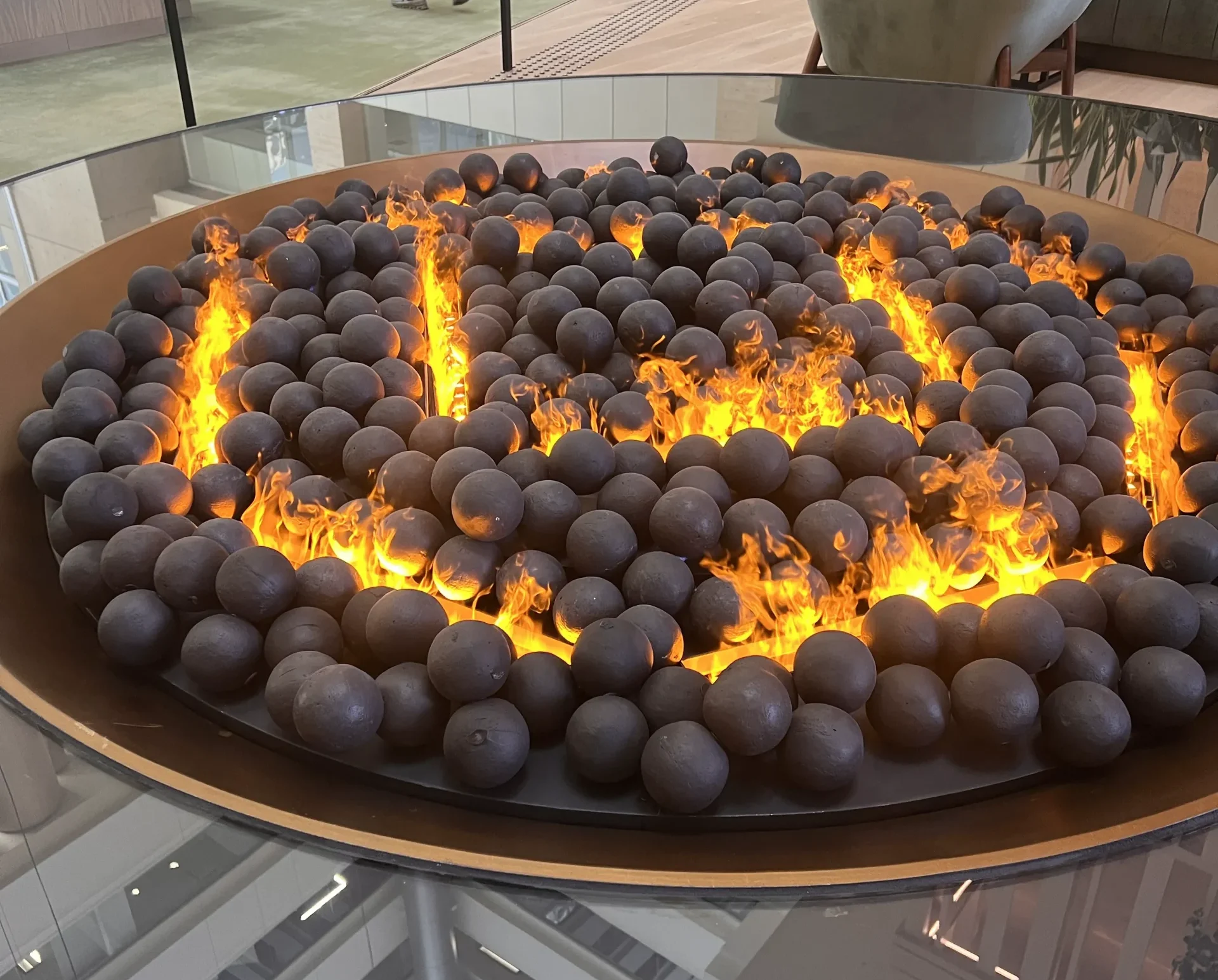
Sloan says that while people will walk in and enjoy the atmosphere and seating, the building was redesigned to appeal, first and foremost, to the tenants who come to work every day.
“The main purpose is hospitality for our tenants, which is our primary customer,” he says, adding that hosting larger events in the future is also a possibility, provided they don’t take away from the primary purpose of serving workers.
Building tenants are responding positively, Sloan says.
“So far, the feedback’s been really good. I know from our team, as our office is here, there’s been a lot of coffees and meetings and ad hoc conversations that are taking place in this lobby that would have otherwise maybe happened at a coffee shop. So it’s a nice place to interact with your colleagues as well as call in business associates who don’t occupy this building.”
The Power Lunch
With return-to-office mandates in full effect, some have learned that the best way to win the hearts of workers is the oldest trick in the book — food.
Urban centres have often been ideal for power lunches, as towering office buildings (especially in Toronto) are anchored by countless restaurants vying for a piece of the lunch rush.
However, with a less-than-thrilled workforce returning after half a decade working from home, and a new generation of workers entering the office for the first time, many are realizing that comfort needs to be stitched into office culture, if there is to be any hope of worker retention.
While new urban offices in the heart of Canada’s largest downtown are trying to stimulate those clocking in with statues, light shows, and lots and lots of plants, the powers that be know this novelty will quickly wear off after a few gruelling commutes to work.
So, in an effort to remove the stain of the 2000s and 2010s, where an in-office catering bonanza was flat pop and a cold slice of pizza, new players have entered the scene to make office work feel more like the living rooms many were used to working from.
Recent numbers from Deloitte showed that when office managers actually shell out for a consistent (and actually good) food selection, productivity sees an increase of 18 per cent across the board.
Cashing in on the current return-to-office boom, and looking at these numbers as a launchpad, Nüu Catering sat down with INsauga.com and discussed how employers lost the plot on the ‘labour force plus fed equals happy’ equation.

“We see ourselves as office culture enhancers, and this is very important to the new generation,” Fahim Ahmadi, cofounder of Nüu Catering, tells INsauga.com. “Workplaces need to keep [workers’] attention, as they are looking for something adventurous and unique, and a cold cheese platter isn’t going to do that.”
On paper, Nüu functions as a platform to cut through the red tape of supplying a viable spread for 100+ people, as those running the show can tap into an entire theme park of local downtown restaurants and cater around the needs of the office through their service.
“We essentially break down the top restaurants in the city — within the parameters of that physical office — who do catering. Then once that is set, you can have a rotating selection of orders per week to line up with meetings, or mix things up to close out Friday,” says Ahmadi.
Ahmadi noted that Nüu’s goals lined up with offices that caught on early, as while a decade ago a curated lunch (on company dime) was relegated to once or twice a year, now offices that want to entice, and more importantly, retain, are making it akin to once or twice a week.
As a result, before the sweeping return-to-office mandate many launched this summer, Nüu held several studies, surveys and interviews to discern what would entice returning and young professionals to stick around in their cubicles.
“A lot of employees have been naturally asking, ‘why should I come in?’ They’ve been productive working from home and have years of evidence to back that. They need something to make it worthwhile,” says Ahmadi.
This makes Nüu a modern shoo-in, as lukewarm boardroom banquets are something anyone commuting for the first time in six years would rather leave in the bygone age of pre-pandemic office culture.
Being modern opportunists, Nüu has established footholds in both Toronto and Mississauga’s urban office centres, and has made itself stand out by having a streamlined interface that accounts for allergies and dietary restrictions.
Something that Ahmadi states is critical as returning workers, now in their mid-thirties, and the new ones fresh off campus, just in their twenties, both have healthier options in mind.
Beyond the application of their services, Ahmadi also believes that, beyond a craving for healthier options beyond a group order at Mickey Dee’s, those returning to the office want some sense of community.
“Catering used to be only relegated to like, the office staff party or the holidays, but now, with modern expectations, people want something that brings them together, and when you do that a couple of times a week, it becomes part of the culture,” says Ahmadi.
A more nuanced take on catering also helps sustain the office itself; if your entire office culture sprints to the doors at noon to grab lunch, that’s as likely a sign as any that they would rather be anywhere else.
In turn, Ahmadi states that if restaurants want to get as much bang for their buck in the new office era, and offices want to keep workers from finding work-from-home jobs elsewhere, everyone needs to play ball.
“People are craving something unique, and beyond that, multicultural. So if restaurants around these offices want to get in on the new work culture, they need to start to get in on office catering, or risk being left behind.”
– With files from Ashley Newport and The Canadian Press
PollView All
WIN A $100 GIFT CARD
Subscribe to INsauga’s daily email newsletter for a chance to win a $100 Amazon gift card.