
More Mississauga lawns could soon be natural and un-mowed.
A city committee approved a new bylaw regulating weeds and tall grass on private property. The bylaw would replace the Nuisance Weed and Tall Grass Control bylaw, which prohibits grass over 20 centimetres in height and certain nuisance weeds on personal property.
The change comes after a court decision this winter.
In January, Mississauga resident Wolf Ruck won a court challenge, protecting his right to “maintain a naturalized garden on his property with tall grass and nuisance weeds” as it is protected under the Charter of Rights and Freedoms. The right is not a total freedom, but the city needs to provide evidence of a safety or health hazard.
Ruck has fought the bylaw since 2021.
City of Mississauga staff reviewed the approaches of Brampton, Hamilton, Toronto, Vaughan and Oakville on tall grass and weeds, staff said in a report to the General Committee on April 8.
Under the city’s proposed changes, there would be “flexibility for residents in how they manage their properties.”
The new bylaw introduces the term “turfgrass,” defined as a ground cover of perennial grasses cultivated for lawns that forms a dense and uniform turf when mown. Staff recommends keeping turfgrass to a maximum height of 20 centimetres, while other types of grass may exceed that height.
“When turfgrass is allowed to grow beyond a certain height, it can reach a flowering stage that contributes to pollen-related allergies,” a report to the committee states. This threshold also reflects common height standards in other North American communities.
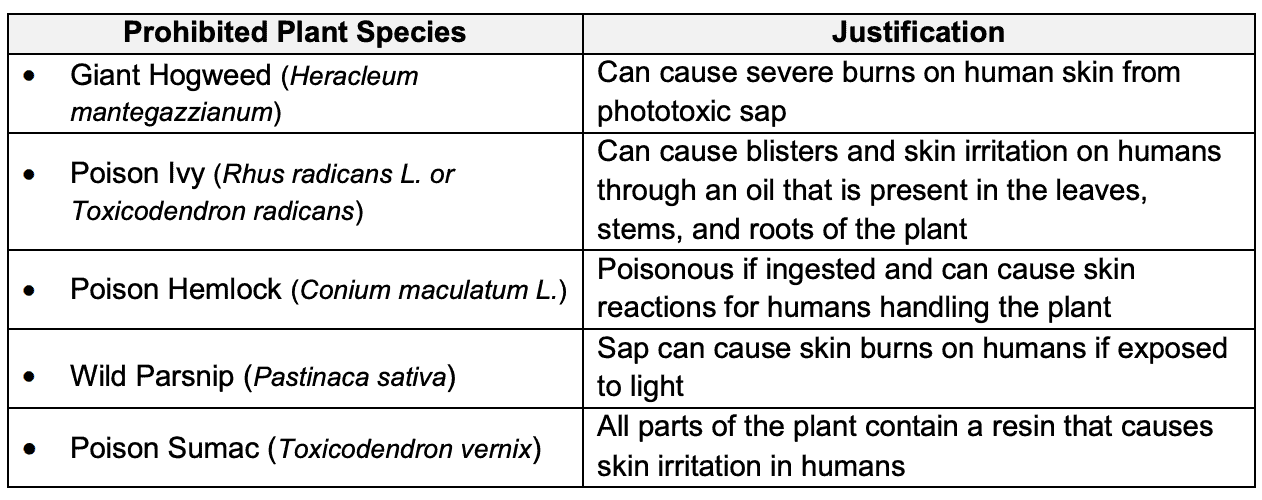
The bylaw also reduces the number of prohibited plants to five.
The following plants would be prohibited under the new bylaw:
Lorraine Johnson, a writer and advocate for grass and prohibited plant bylaw reform, was one of the experts consulted on the new bylaw. Johnson commended staff on the work done on the new bylaw, which is simple, straightforward and clear.
“I think the staff recommendations are a model of clarity for these bylaws,” she said at the April 8 meeting.
She said the new bylaw will require public education and training of officers.
Coun. Dipika Damerla asked why the list of prohibited plants has been reduced to just five, noting that the list of invasive species is much longer.
“I do think the five we have landed on is too narrow,” Damerla said. “Because I am very passionate about native plants and bringing back, as much as we can, native plants, which unfortunately don’t thrive, I mean they lose in the competition with invasive species.”
Johnson said many of the plants on invasive species lists are harmful in agricultural settings, but not in urban areas. She said the current advice for bylaws is to keep the prohibited plants list lean.
However, the committee agreed to have city staff revisit the list of prohibited plants and come back with reasons why some plants are not included.
Karen Barnes, who has a master’s degree in ecology and is began re-wilding her Burlington yard in 2015, argued the proposed bylaw doesn’t go far enough. She said there shouldn’t be height restrictions on turfgrass.
Barnes said people often transition to re-wilding or naturalization by leaving turfgrass un-mowed.
Turfgrass is used to create meadows, she argued.
The committee, however, did not suggest changes to the regulations on turfgrass.
The bylaw will need final approval from council. For more information, see the General Committee meeting here.
Lead photo: Magic K
INsauga's Editorial Standards and PoliciesPollView All
WIN A $100 GIFT CARD
Subscribe to INsauga’s daily email newsletter for a chance to win a $100 Amazon gift card.