

Home prices have dropped in Ontario and across Canada since 2022 but some cities saw more significant declines than others.
After years of runaway price growth, Canada’s housing market is undergoing a significant reset, according to a new report from real estate brokerage Zoocasa.
Zoocasa used data from the Canadian Real Estate Association to analyze home sales and price changes across Canada over the past three years.
Some of the most significant corrections in the housing market have occurred in Canada’s priciest regions, especially Ontario and British Columbia, the report states. Sales have significantly slowed in urban centres where prices surged during the pandemic.
In the Greater Toronto Area, many homeowners have sold at significant losses after buying a peak-high prices in early 2022. A Mississauga property sold for a $445,000 loss and an Oshawa home sold for a $510,000 loss in February this year.
Hamilton saw the biggest price drop in Ontario—from a home price average of $1,104,441 in February 2022 down to $813,548 in 2025. Kitchener-Waterloo was next with a drop from $1,010,151 in 2022 to $786,766 in 2025. The Niagara Region is next with some of the lowest prices in southern Ontario, down to $672,804 in 2025 from $859,477 in 2022.
Home price change from February 2022 to February 2025
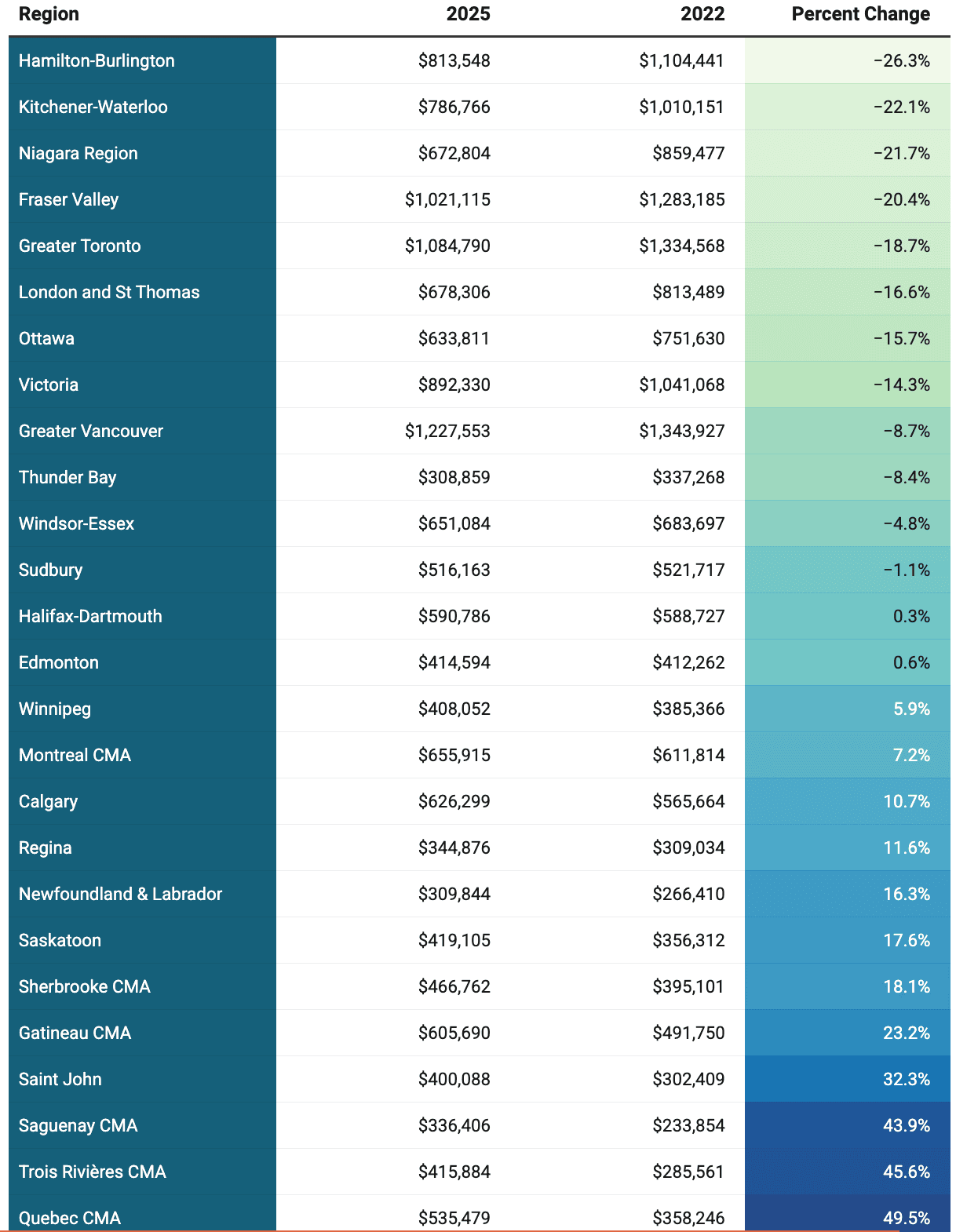
While prices are lower than in 2022 in most cities, some places saw a boost in the beginning of 2025. The market could change, however, with the impact of tariffs and uncertain economic conditions.
Kitchener-Waterloo, Sudbury, the GTA and the Niagara Region are among the cities that have seen slight home price increases from February 2024 to 2025, according to the report.

The number of homes sold has also declined in many cities. From 2022 to 2025, sales in the GTA dropped by 55.6 per cent, Zoocasa found. But Kitchener-Waterloo saw the biggest decrease, 58.5 per cent, in Ontario. Other parts of Ontario also experienced notable drops, with Ottawa down 51.7 per cent and Hamilton–Burlington declining by 50.9 per cent.
Regions hit hardest by sales declines tend to have one thing in common: high home prices. Cities like Toronto, Fraser Valley, and Ottawa, where mortgage burdens are among the highest in the country, have proven especially sensitive to interest rate hikes, Zoocasa said.
“As borrowing costs surged, so did monthly payments, creating widespread buyer hesitation,” Zoocasa said in the report. “In turn, sales froze, inventory built up, and prices began to soften. It’s a clear cause-and-effect cycle: the more expensive the market, the more fragile it becomes under financial pressure.”
See the full Zoocasa report here.
INsauga's Editorial Standards and PoliciesPollView All
WIN A $100 GIFT CARD
Subscribe to INsauga’s daily email newsletter for a chance to win a $100 Amazon gift card.