

Two students from Peel Region represented Canada in an international science showcase with a project on dementia.
Mississauga Grade 11 student Maanya Shah and Brampton Grade 12 student Aarsh Patel joined a team of Canada-wide science fair finalists at MILSET (International Movement for Leisure Activities in Science and Technology) Expo-Sciences International showcase in Abu Dhabi from Sept. 27 to Oct. 3.
“It was amazing,” Maanya told INsauga.com. “It was one of the best experiences imaginable, especially in high school, travelling abroad. There were people from all over the world that have such different ideals and ideologies and different ways to conduct science, and they all think differently, so it was just something that was so great to see.”
Maanya and Aarsh were part of the team of 36 Canadian students from six provinces who joined nearly 1,000 young scientists from 45 countries. The weeklong event offers a chance for students to showcase their STEM projects, participate in workshops and connect with their peers.
To get to the international showcase, Maanya and Aarsh won first at the Peel Region science fair with their project on AI and dementia, and then took bronze at the Canada-wide science fair, hosted by Youth Science Canada.
The students attend two different high schools — Aarsh at Central Peel Secondary School, and Maanya at St. Francis Xavier Secondary School — but as family friends, they have been working together for years.
Maanya’s grandmother was diagnosed with Alzheimer’s disease, the most common form of dementia.
“We’ve experienced it firsthand, seeing the effect of Alzheimer’s,” said Aarsh.
Aarsh added that he has a rare genetic neurological condition where a part of his cerebellum has grown around two to three centimetres into his spinal canal. He had surgery this summer, but the condition has impacted his ability to study in the past.
“I was like, if I’m struggling from this, somebody who has such a bigger condition like Alzheimer’s, they would be struggling way more,” Aarsh said. “Both of those experiences drove us to really use our passion for science to make an impact in this space.”
Basically, their project is an AI predictive model to catch Alzheimer’s early. They started with inflammatory bowel disease because those with IBD have a four times greater risk of developing Alzheimer’s. But they had challenges finding data, and broadened the parameters.
But the goal remains the same.
“It’s aiming to help physicians catch Alzheimer’s earlier, so that they can help slow the progression and help people hold on to those moments and get a better quality of life for more years,” said Aarsh.
They created portable devices to gather brainwave signals and blood biomarker data, which could be taken into rural communities.
“We really want to make this accessible to other people and physicians around the world,” said Maanya.
Their end goal is to take their work into clinical testing, as right now it is in the experimental phase, she added.
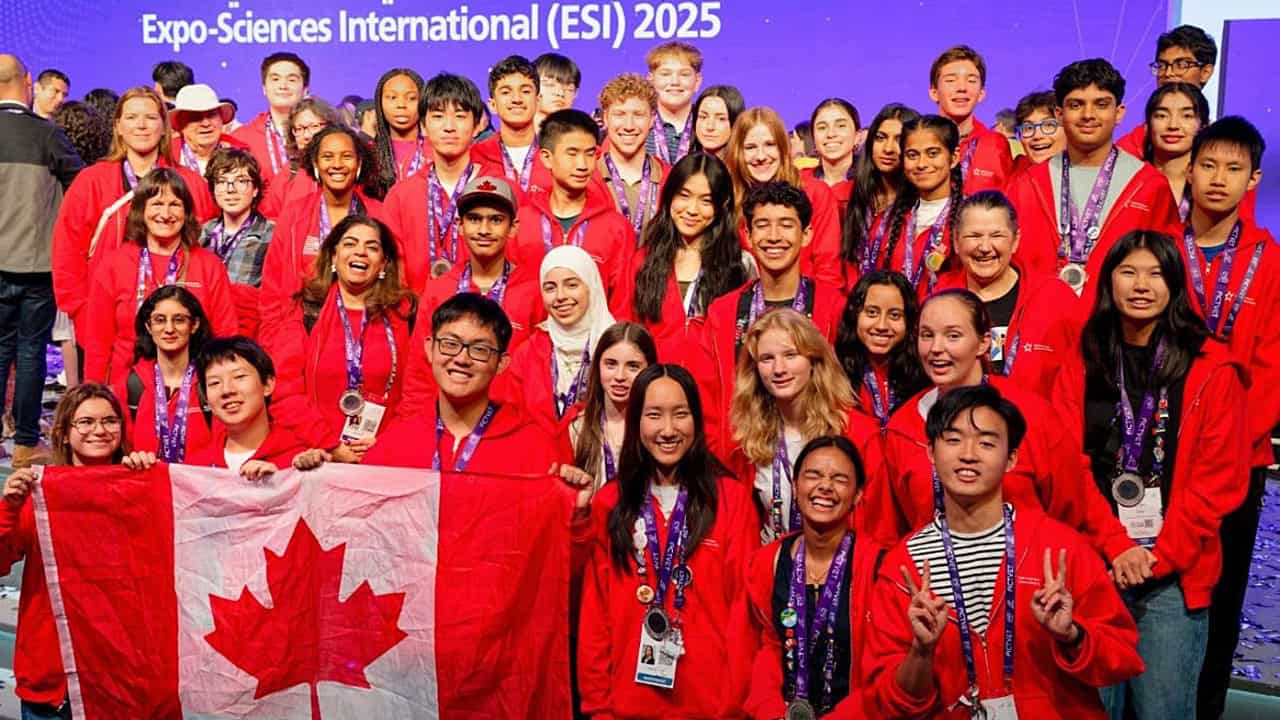
Maanya and Aarsh were part of the team of 36 Canadian students from six provinces who joined nearly 1,000 young scientists from 45 countries in Abu Dhabi.
They are working with a professor at the University of Pennsylvania to help get data sets, and the experience in Abu Dhabi opened more doors.
“We got to meet a lot of amazing people, like doctors, especially people from Abu Dhabi itself…we got a lot of good feedback to improve our project, and a lot of great ideas,” said Maanya. “We got to see a lot of other projects regarding Alzheimer’s and different medical and AI-related (projects). So, we got a lot of new ideas and factors to put into our AI that we wouldn’t have thought of before talking to new people and seeing what they’re doing in different countries regarding Alzheimer’s.”
They hope that after years of work on this project, it will be used to help people.
“This isn’t a science project,” Aarsh said. “This is something that we really want to push, to have people actually use.”
Both students are planning careers in the sciences — Aarsh in medicine and Maanya in computer engineering.
PollView All
WIN A $100 GIFT CARD
Subscribe to INsauga’s daily email newsletter for a chance to win a $100 Amazon gift card.