
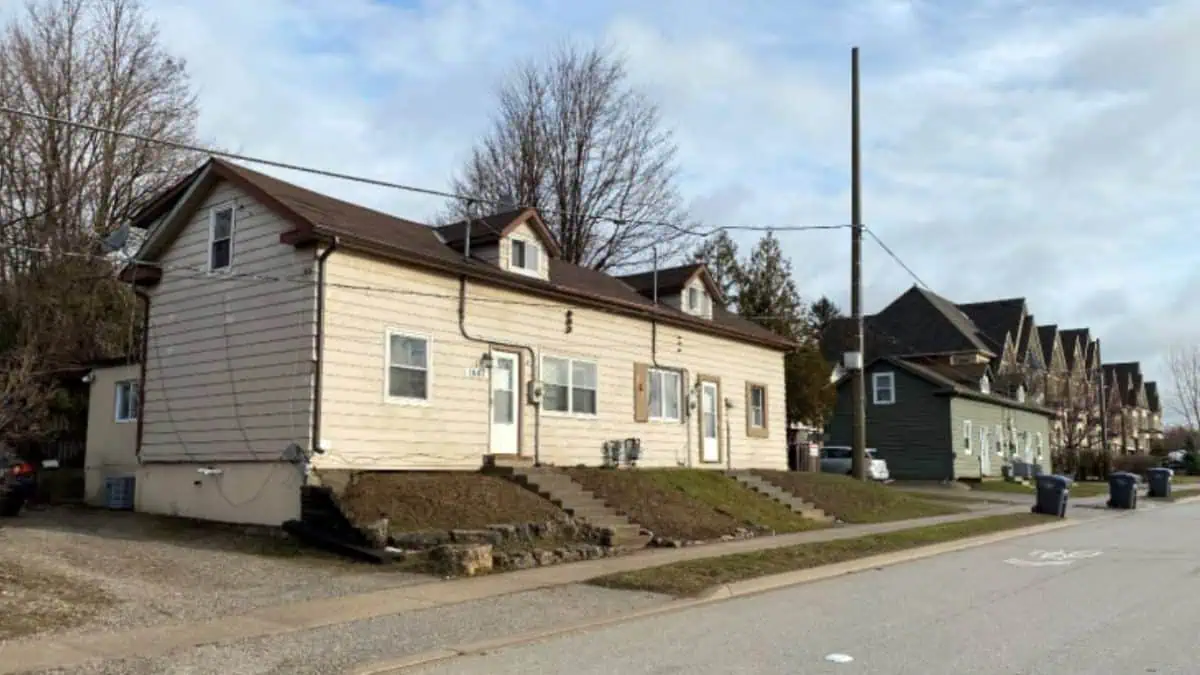
Long before Mississauga became a city of subdivisions, office towers and highways, workers at one of Ontario’s largest textile mills walked home each day to modest cottages overlooking the Credit River. Today, just two of those homes remain, providing a rare link to the city’s industrial beginnings.
The City of Mississauga’s Heritage Advisory Committee is recommending the duplexes at 1595-7 and 1605-7 Eglinton Avenue West be designated under the Ontario Heritage Act, recognizing them as the last surviving millworkers’ cottages connected to the once-thriving Barberton industrial community near Streetsville.
While the one-and-a-half-storey homes may not stand out to most people driving along Eglinton, city heritage staff say the structures represent an important chapter in Mississauga’s history and offer one of the few remaining glimpses into the lives of the working families who helped fuel the city’s early industrial economy.
If approved, the heritage designation would formally recognize the properties for their historical, architectural and contextual significance while requiring city approval before they can be demolished or altered in ways that would affect their identified heritage features.
According to a city report, the homes were built in 1860 by the Barber Brothers, pioneering industrialists who established the Toronto Woollen Mills along the Credit River after purchasing land south of Streetsville in the 1840s.
The mill quickly became one of the province’s manufacturing success stories.
By the 1860s, the Toronto Woollen Mills was producing roughly 1,000 yards of cloth each day and employed about 100 workers. At its peak, the operation grew to employ as many as 200 people and, by 1870, had become the fourth-largest textile mill in Ontario.
The success of the operation led to the creation of an entire company community known as Barberton, centred around the mill near what is now Barbertown Road.
The Barber Brothers built 43 structures to house workers and their families, along with shops, a boarding house, recreation areas and other amenities that transformed the area into a bustling industrial village.
Many employees lived within walking distance of the mill, and in some cases entire families worked there. Skilled weavers were recruited from Scotland, while local businesses, including a blacksmith shop, tailor shop and general store, supported the growing community.
Today, however, almost all of Barberton has disappeared.
The two duplexes proposed for heritage designation are the only surviving millworkers’ cottages from the original community. Heritage planners say they are just as important to understanding the area’s history as the nearby William Barber House on Mississauga Road, which was built for one of the mill owners and is already designated under the Ontario Heritage Act.
Together, the buildings tell the story of both the people who owned one of Ontario’s largest textile operations and the workers whose labour made it successful.
“The cottages are an important aspect of Mississauga’s socioeconomic and industrial history,” the city report states.
Although the textile operation collapsed in the early 1880s, the mill site continued operating under various owners before eventually being converted to flour production. Today, the former mill survives as the ADM milling operation on Barbertown Road, making it one of Mississauga’s oldest continuously operating industrial sites.
City staff say preserving the cottages helps maintain that connection to the past.
The proposed designation does not prevent the homes from being occupied, maintained or renovated. Instead, it protects the buildings’ identified heritage attributes, meaning future demolition or alterations affecting significant exterior features would require municipal approval.
Among the heritage features identified by the city are the buildings’ duplex form, medium-pitched gable roofs, dormers, chimneys and original window and door openings.
Not everyone supports the proposal.
According to the report, heritage staff met with the property owners in 2025 and again in early 2026 to discuss the houses. Despite those discussions, the owners have indicated they are not in favour of the heritage designation.
City staff nevertheless concluded the cottages meet multiple criteria for designation under the Ontario Heritage Act because of their physical, historical and contextual value.
Nearly 170 years after they were built, the modest duplexes remain among the last tangible reminders of Barberton, a once-bustling mill village whose workers helped lay the foundations of Mississauga’s industrial heritage.
INsauga's Editorial Standards and Policies
PollView All
WIN A $100 GIFT CARD
Subscribe to INsauga’s daily email newsletter for a chance to win a $100 Amazon gift card.