

Canada’s most prominent nuclear advocate believes spending more than $6 billion on a small modular reactor powered by U.S. technology when Canadian nuclear tech is right in front of our noses is a mistake.
Deciding to spend that cash – nearly $21 billion on four of them when the site at Darlington Nuclear is fully built out – on BWRX-300 reactors in the middle of a trade war with U.S. President Donald Trump will prove to be an even bigger gaffe, said Canadians for Nuclear Power President and co-founder Dr. Chis Keefer.
“What are we even doing,” Keefer asked. “This was a theoretical risk before the Trump era. It is now a clear and present danger.”
The Ontario government has approved Ontario Power Generation’s plan to build four small modular reactors (SMRs) at the Darlington site, a first of its kind in the G7 that will producing enough clean electricity to power the equivalent of 1.2 million homes when complete, supporting thousands of jobs across the province and helping secure Ontario’s energy supply for decades to come.
Queen’s Park says the project will begin this year and be ready to go by 2030.
Keefer, an emergency room doctor when he’s not advocating for nuclear power, said a full-scale build using CANDU technology was the way to go, pointing out that Ontario has a functioning, Canadian-led nuclear industrial base, a generation of CANDU-trained engineers and skilled craft labour and a track record of delivering on-budget, on-time mega-projects.
“Through our $26 billion CANDU refurbishment program, Ontario has built something truly extraordinary,” Keefer noted. “And now we’re gifting the fruits of our labour and investment to a private, U.S.-owned design – in the midst of an unprovoked trade war.”
Ontario Energy Minister Stephen Lecce, however, called it an “historic day” when the SMR project was officially announced last week.
“This nation-building project being built right here in Ontario will be led by Canadian workers using Canadian steel, concrete and materials to help deliver the extraordinary amount of reliable and clean power we will need to deliver on our ambitious plan to protect Ontario and unleash our economy.”

Dr. Chris Keefer, Canadians for Nuclear Power
Keefer, while admitting he has “massive respect” for OPG for bringing in refurbishment projects at Darlington and at the Pickering nuclear sites on time and on budget, as well as “competently managing” those major nuclear plants, said using CANDU technology – not diversifying nuclear technology during “uncertain economic times” caused by U.S. tariffs – would have been the far better call.
“Bringing in a boiling water technology just complicates things,” he said, noting the SMRs require U.S. supply chain tech as well as enriched uranium, which CANDU reactors do not.
“Why do that when we’re ready to pass the baton from CANDU refurbishment to CANDU rebuild, and when we have a supply chain and workforce intimately familiar with the technology?”
Keefer said pivoting to SMRs means taking on finance and construction risk for U.S. technology “we don’t control” and depending on foreign fuel to make the project work.
It also means “surrendering” a fully licensed nuclear site at Darlington (4,800 MW) to host just 1,200 MW from four small reactors, he added. “We’re doing the U.S. nuclear industry an enormous strategic favor.”
Keefer also disputes Lecce’s claims that the deal comes with guarantees from GE Hitachi of a “big piece” of the global SMR market. The U.S. Secretary of Energy – a presidential appointee – governs all future contracts of U.S.-origin nuclear projects, he pointed out. “Under a protectionist White House, Canada could be disadvantaged in future exports, no matter what GE Hitachi promises.”
“It will face tariffs, localization mandates and U.S. protectionism.”
The GE Hitachi BWRX technology is also expensive and not as groundbreaking as Lecce and others would have us believe, he added. “Ontario leaders have been seduced into thinking that SMRs are a revolutionary breakthrough with a massive global market opportunity for Ontario. The BWRX-300 is in fact a scaled-down light water reactor – the most special thing about SMRs are the ‘diseconomies’ of scale.”
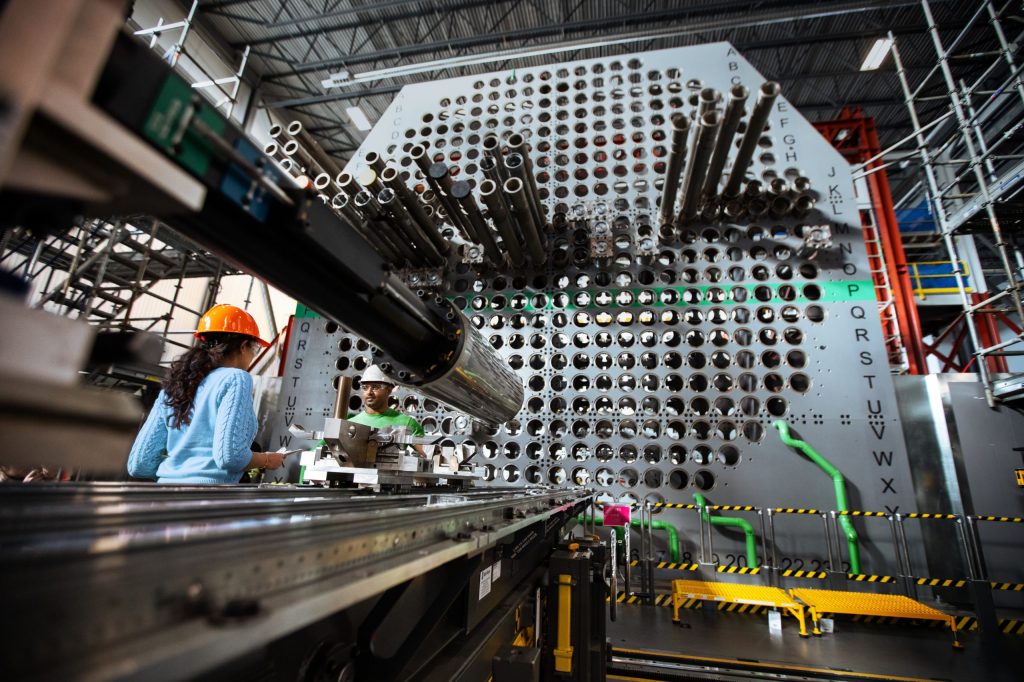
Ontario is banking on other jurisdictions in western Canada following suit to make the numbers work but Keefer believes there is no guarantee that will happen either. “In reality Saskatchewan and Alberta are unlikely to spend $6 billion for 300 megawatts when they can build combined-cycle gas plants for less than $1 billion – six times cheaper at a time when climate policy is playing second fiddle to affordability and national unity.”
Using enhanced home-grown models like CANDU 6s (740 MW each) while the bugs are being worked out of 1,000 MW CANDU Monark reactors would have been a far more prudent decision, Keefer said. “This alternative strategy would retain and build upon Canadian intellectual property, jobs and export leverage and make us stronger in the face of U.S. economic pressure.”
The BWRX-300 is a small-scale nuclear reactor that will produce 300 MW of power each, with the construction of the four units expected to inject $500 million annually into Ontario’s economy. The construction, operation and maintenance of the four units will potentially add $38.5 billion to Canada’s GDP over the next 65 years.
The province has worked with OPG to ensure that 80 per cent of project spending goes to Ontario firms and more than 80 Ontario companies have already signed agreements to deliver this first-of-a-kind project.
More electrical capacity – a lot more – will be needed in the coming years as the Independent Electricity System Operator said last year that electricity demand is expected to increase by 75 per cent by 2050.
The good news is the province is exploring a new, large-scale plant at Bruce Power on Lake Huron and a new nuclear plant near Port Hope, just east of Darlington.
CANDU technology is definitely still in play for those projects. It’s just unfortunate that tech wasn’t given the nod when the SMRs were chosen for Darlington, Keefer said.
“With this decision we are not protecting Ontario. We are making it vulnerable. We are gifting the fruits of our nuclear industrial revival to the U.S.”

Furure SMR site at Darlington Nuclear
PollView All
WIN A $100 GIFT CARD
Subscribe to INsauga’s daily email newsletter for a chance to win a $100 Amazon gift card.