

As home sales remain slow, a few neighbourhoods in the Greater Toronto Area are seeing some overbidding activity.
There was some bidding competition among homebuyers who dipped their toes in the market in February, a new report from digital real estate platform Wahi found.
The share of Greater Toronto Area neighbourhoods in overbidding territory roughly doubled between January and February, Wahi said in the report. In February, 51 neighbourhoods (20 per cent) with at least five home sales were in overbidding territory, compared to 26 (11 per cent) in January. This is the highest level of overbidding activity since June 2024, when 82 neighbourhoods (27 per cent) overbid.
Still, the real estate market isn’t booming. A total of 194 neighbourhoods (77 per cent) remained in underbidding territory in February, while another eight (three per cent) saw homes selling at the asking price.
“The rise in bidding activity is encouraging, but it’s not unusual to see swings in the market ahead of the normally busy spring homebuying season,” said Wahi CEO Benjy Katchen.
Last year, the share of neighbourhoods in overbidding territory went from zero to 25 per cent between January and February.
“Although there were signs of a more competitive GTA housing market this February, buyers were still in command overall,” Katchen said.
The average selling price of all home types came in at $1,084,547 in February, down by 2.2 per cent compared to February 2024, according to the Toronto Regional Real Estate Board.
The median price of a GTA home in February was $940,000, a four per cent decline from a year ago, according to Wahi. The median price is the price in the middle when all home prices are listed, while the average price is the total sum of all home prices divided by the number of homes. Median price is less affected by extreme values.
Home sales are down overall with a total of 3,977 homes sold across the GTA in February, representing a 30 per cent decline from the same time last year.
And most homes—65 per cent—sold for less than the asking price, Wahi found. This is down from 74 per cent in January. The most popular type of home is a single-family (detached, semi-detached or townhouse). Some 39 per cent of single-family homes sold for more than the asking price last month, a substantial increase from 26 per cent in January.
The condo market remains subdued as fewer than one-in-five condos (19 per cent) sold for above the asking price in February, compared to 16 per cent in January.
“For now, it remains a tale of two markets in the GTA. Competition for single-family homes is much stronger than demand for condos,” said Katchen. “Looking ahead, we’ll be watching to see whether the reality of U.S. tariffs impacts homebuyer plans and changes the storyline.”
Here are the overbidding and underbidding neighbours in the GTA.
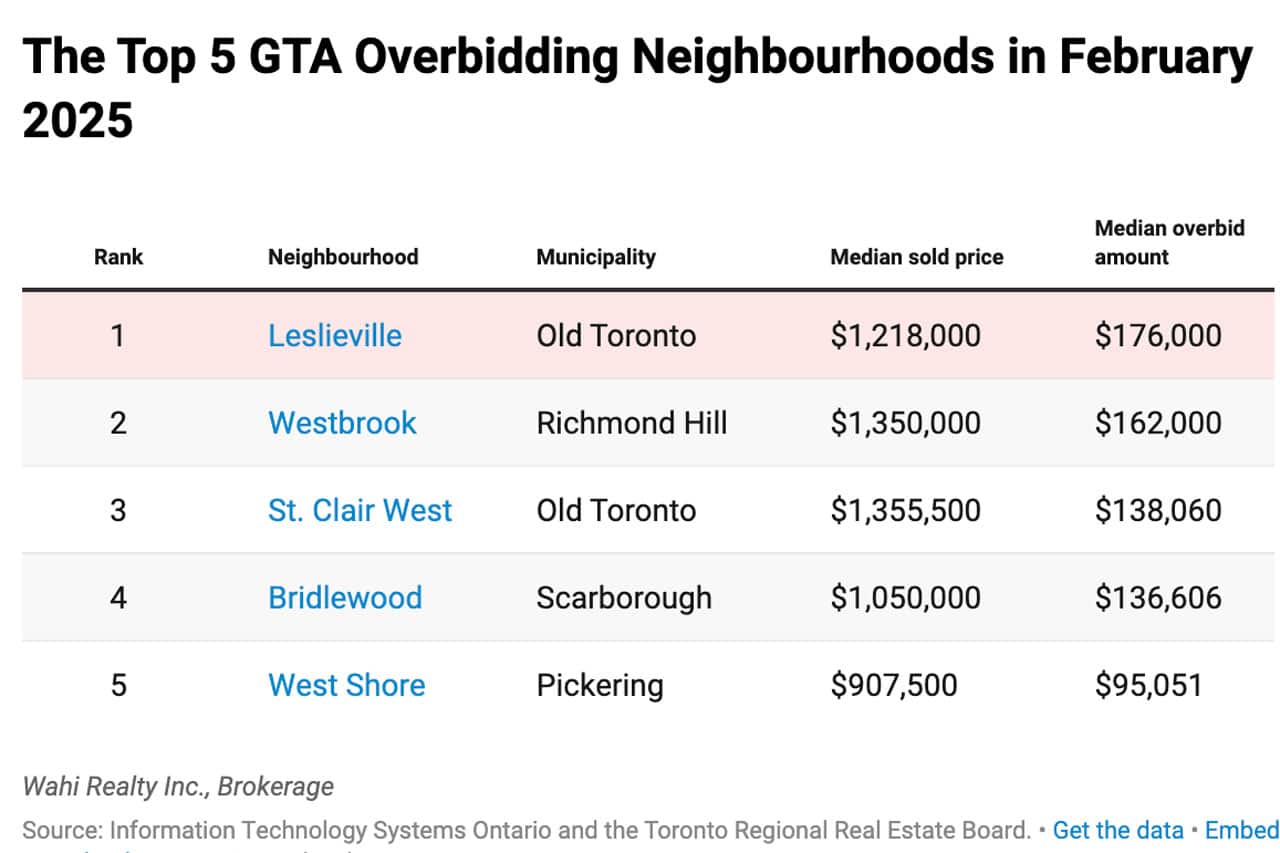
Wahi noted that when a neighbourhood is in overbidding territory, it doesn’t mean that every home is selling for above the asking price. Nor does it mean that buyers are paying more than a home is worth. Instead, it’s a general reflection of market behaviour, which can be influenced by seasonal factors, for example, or decisions by sellers, such as to list homes below market value to try and attract more bids.

At the end of each month, Wahi compares the differences between median list and sold prices to determine whether neighbourhoods are in overbidding or underbidding territory, excluding those neighbourhoods with fewer than five transactions in a given month.
A total of 253 neighbourhoods out of the GTA’s approximately 400 met this threshold in February, up from 236 in January. Data is sourced from Information Technology Systems Ontario and the Toronto Regional Real Estate Board.
For more information see the full report from Wahi here.
INsauga's Editorial Standards and PoliciesPollView All
WIN A $100 GIFT CARD
Subscribe to INsauga’s daily email newsletter for a chance to win a $100 Amazon gift card.