

It was 35 years ago yesterday when Canada’s greatest thoroughbred, and arguably the one horse who had the greatest impact on champions from around the world who came after him, was laid to rest in Oshawa.
Northern Dancer, who captured the hearts of the nation in 1964 when he won the Kentucky Derby, the Preakness Stakes and the Queen’s Plater, would go on to enjoy a celebrated life in the stud barn as one of thoroughbred’s greatest ever sire.
Born at E.P. Taylor’s Windfield Farms racing stable in Oshawa in 1961, Northern Dancer first earned his stripes on the track and his status as Canada’s most successful racehorse is unchallenged, with Los Angeles sports writer Jim Murray once saying of the undersized colt that he “probably took a hundred more strides than anyone else but he was harder to pass than a third martini.”
But it was his life on the stud farm and his legacy as the greatest sire of the 20th century (and beyond) that truly earned the horse global fame.
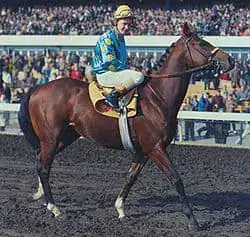
Northern Dancer was an immediate hit in the breeding barn – nearly half of his first crop became stakes winners and his second crop, led by English Triple Crown winner Nijinsky, brought his name to the international stage.
His fame necessitated a move to Taylor’s Maryland operations in 1968 and he quickly became the most sought-after sire of his time, with his stud fees eventually reaching $1 million, the first horse to ever do so.
By the time of his death at the ancient age of 29 in 1990, more than two-thirds of all his foals had won races and a quarter had become stakes winners. Nearly 70 per cent of all thoroughbred horses racing today can trace their lineage back to him.
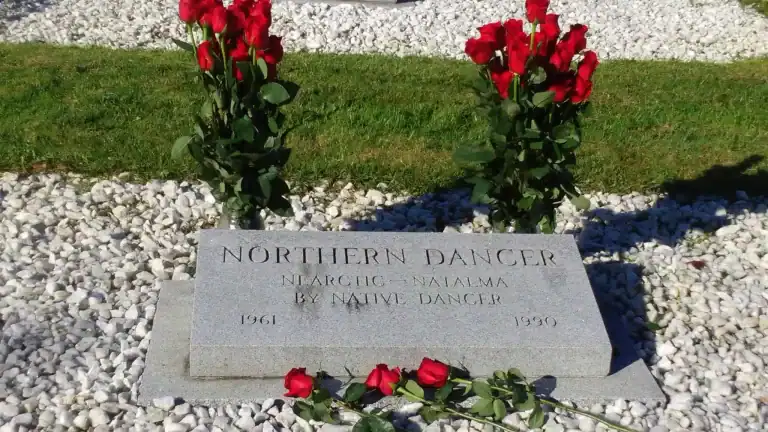
After his death Northern Dancer was loaded in a specially built oak coffin, wrapped in a blanket he had won during his racing career and brought back to Canada in a refrigerated van for burial at Windfields Farm.
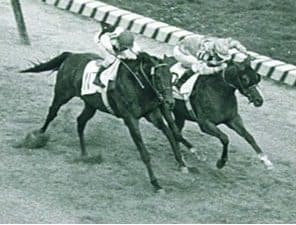
The Dancer died at 6:15 a.m., his body was loaded and shipped out of Northview Stallion Station in Maryland – where he was living out his golden years – by 7:30 a.m., and he was in Canada by 9 p.m. They dug his grave while he was in transit.
The final resting place of one of Canada’s most famous sporting icons lies tucked away between a university campus and new residential neighbourhoods in north Oshawa – its history unknown to generations of the city’s citizens – but the little horse that could rarely rested on the track, winning 14 of 18 races in his brief career, and never finishing worse than third.
The farm closed in 2009, with most of the 600-acre property sold to Durham College (and subsequently transferred to Ontario Tech University) and Northern Dancer’s burial site was not publicly accessible for many years, at one point becoming covered in weeds.
The grave, which also contains the remains of ten other horses (including 1960 Queen’s Plate winner Victoria Park) became an official heritage site in 2018, with the university tasked with maintaining and preserving the site.
The Canadian Horse Racing Hall of Fame, based at Woodbine Racetrack in Toronto has called the site “one of the most iconic properties associated with Canadian horse racing.”
Northern Dancer was inducted into the Ontario Sports Hall of Fame in 1998 and the following year the horse was honoured with his image placed on a postage stamp.
That same year a life-sized bronze statue of the Northern Dancer was placed outside Woodbine’s main entrance, a reminder of his legacy for racegoers attending subsequent running’s of what is now called the King’s Plate.
INsauga's Editorial Standards and Policies
PollView All
WIN A $100 GIFT CARD
Subscribe to INsauga’s daily email newsletter for a chance to win a $100 Amazon gift card.