
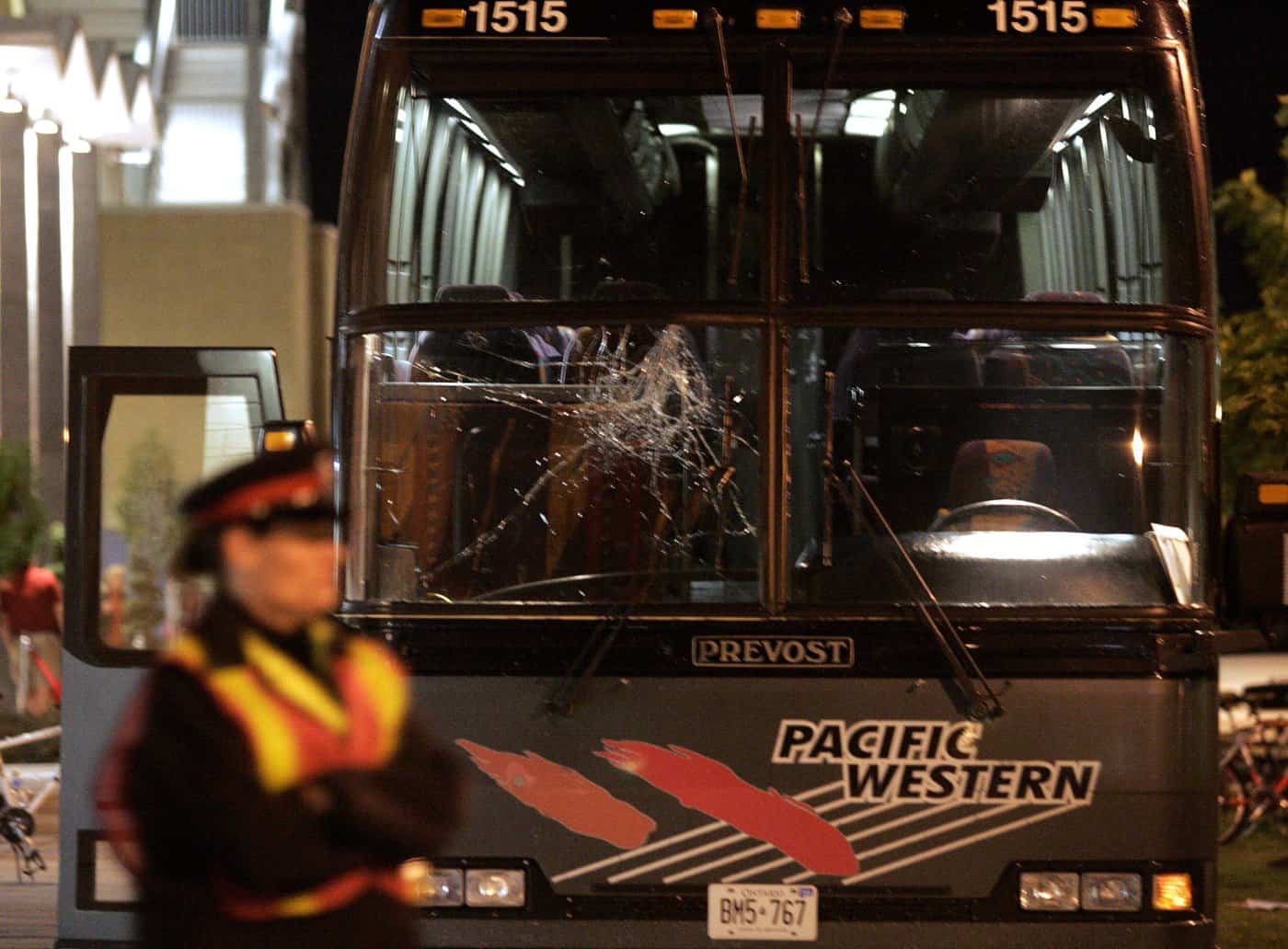
TORONTO — After interviewing players under a makeshift tent outside BMO Field at the FIFA U-20 World Cup in 2007, reporters were set to return to the media workroom when story plans changed.
Argentina’s 3-0 win over Chile in an ill-tempered semifinal suddenly moved to the back burner.
The more pressing development was a ruckus near the stadium’s main entry area as players on the Chilean team slugged it out with security and police. A member of the Chilean delegation was subdued by a Taser during the bloody brawl.
It didn’t take long for it to become an international incident. Politicians were quick to weigh in, and then-FIFA president Sepp Blatter said the situation left a “black mark” on the tournament.
“International soccer matches are hotly contested and often become very emotional,” Canadian Prime Minister Stephen Harper, in Haiti at the time, said the next day.
Nearly 20 years later, six FIFA World Cup matches will be played at the same venue. Canada, the U.S., and Mexico will co-host the June 11-July 19 men’s tournament.
BMO Field was just a few months old when it co-hosted the under-20 competition that featured stars like Argentina’s Sergio Aguero, American Michael Bradley and Spain’s Gerard Pique.
On the night of the ruckus, Nathan Denette was outside the stadium with a fellow Canadian Press photographer when yelling was heard near the Chilean team bus.
Denette said that at first, there was a commotion between four or five people that escalated when eight to 10 players came out of the vehicle.
“There’s just fists flying everywhere,” he said that night. “Between the cops, the security guards, a couple of ladies were involved that were security. It looked like a big dogfight.”
Social media was in its infancy at the time. Smartphone use was a small fraction of what it is today.
So reporters’ phones — for those who had them — weren’t exactly blowing up as they took in player and coach availabilities around the facility. However, it soon became obvious that a new storyline was developing.
After interviewing the Argentine players, a handful of media members returned indoors when they were told to wait in place.
No other details were provided. Security guards and police officers hovered in the area.
Piercing wails were soon heard down the hall. One reporter said it sounded like a raccoon that had been quilled by a porcupine.
The volume got louder until a visual finally appeared. Handcuffed Chilean players, many with blood and dirt smeared across their chins and uniforms, were being led by police to a nearby locker room.
Tournament officials wearing dark FIFA suit jackets soon followed. Colin Linford, then president of the Canadian Soccer Association, also approached the door.
He looked aghast as he peered inside the room.
An impromptu news conference was scheduled a short time later. A FIFA spokesperson said the entire situation was under investigation by the federation, local organizers, police and the Chilean delegation.
He said Chilean players were detained by police to de-escalate the situation in front of the stadium, adding that no arrests were made and that all players had been released.
The game was an intense battle between longtime South American soccer rivals.
Chile had two players red-carded and received seven of the nine yellow cards issued. Some 53 foul calls were made.
After the final whistle, several Chilean players tried to get at German referee Wolfgang Stark and the officiating crew before others stepped in to keep them away.
“The players were upset,” Chilean coach Jose Sulantay said via an interpreter. “They’re young players. The red cards affected them.”
The off-field brouhaha made headlines around the world.
The next day, Blatter, Linford and other soccer officials attended a packed news conference at a downtown conference room.
Blatter said he spoke with Toronto Mayor David Miller to “express the regrets of FIFA,” and asked the CSA to deal with the relevant domestic authorities and report back to FIFA.
Chilean official Harold Mayne-Nicholls was also on the dais.
“We apologize (for) the behaviour of the players after the game,” Mayne-Nicholls said. “We are not supporting (that) kind of conduct.”
He added that he witnessed the incident near the bus.
“I personally saw that the police of Toronto did not act as our police (are) used to acting with people that are just playing a football game,” he said. “For us, as the chairman of the football federation from Chile, we cannot accept those kinds of things coming from the police. Our players are 19, 20-year-old kids.
“They were playing football, and they never deserved the treatment they were receiving.”
Chilean President Michelle Bachelet said it was “clearly unjustified” how the team was treated.
An internal police investigation, released a couple of weeks later, found officers acted with an immense amount of restraint despite being “punched, kicked (and) spat on,” Toronto police chief Bill Blair said.
Blair added the situation started after an altercation between a spectator and a Chilean player. No charges were laid, and there were no serious injuries.
FIFA later handed Chilean forward Jaime Grondona a nine-month suspension and fine for assaulting match officials during the game. The Chilean Soccer Association was also fined for team misconduct.
It remains unclear whether the planned Canadian Soccer Association investigation into the off-field ruckus was completed. Messages left with the federation and the sport’s governing body were not returned.
Chile went on to beat Austria for the bronze medal. Argentina defeated the Czech Republic for gold.
This report by The Canadian Press was first published June 7, 2026.
Gregory Strong, The Canadian Press
PollView All
WIN A $100 GIFT CARD
Subscribe to INsauga’s daily email newsletter for a chance to win a $100 Amazon gift card.