

Waiting for the result of a blood test or biopsy is often agonizing for an anxious patient stuck in limbo, unsure of what (if any) illness they’re dealing with and how (or when) treatment can begin.
The current shortage of lab professionals has prompted medical experts to demand urgent action, especially as the province’s health care system–struggling with long wait times for specialist appointments and certain procedures, as well as overcrowded hospitals–contends with increased demand and an aging population.
The Medical Laboratory Professionals’ Association of Ontario, a non-profit organization that advocates for medical laboratory technologists (MLTs) and medical laboratory assistants/technicians (MLA/Ts), recently said that additional technologists and technicians are needed to address not just aging residents, but also the expansion of preventative medicine and new viruses.
In a report, the MLPAO said lab professionals test for thousands of diseases and disorders, including cancer, diabetes, heart disease, genetic markers and more, and 70 per cent of medical decisions rely on lab results.
To help meet demand, William Osler Health System, which operates Brampton Civic Hospital, Peel Centre for Integrated Health and Wellness and Etobicoke General Hospital, has entered into a first-of-its-kind academic practice partnership with Humber Polytechnic and medical technology company Becton, Dickinson and Company (BD).
The partnership, announced last week at Etobicoke General, will provide a more direct school-to-training-to-employment pipeline for future MLTs and MLA/Ts.
“We looked at how to create an optimal student experience for laboratory students to come to Osler. They have specialized equipment there; we have the same [equipment] here. We build their curriculum so that when they come here, we get to operationalize it. By the time [students] get here, we’re going to have 100 per cent of our laboratory professionals trained to welcome these students,” Tiziana Rivera, executive vice president of quality, research, and chief nursing executive at Osler, tells INsauga.com.
The partnership is open to Humber students enrolled in the college’s medical laboratory technology advanced diploma and the medical laboratory assistant programs. The programming, which launched in 2025, teaches students how to operate sophisticated equipment in microbiology, clinical chemistry, transfusion medicine, histology and hematology.
Rivera says students who train at Osler will learn on the same technology used at Humber.
“We help them operationalize their clinical objectives at the highest level with best practices in mind. So the intention is that they’ll have their experience here and then we want to be able to hire them.”
The aim of the partnership, Osler and Humber say, is to ensure prospective medical professionals graduate with the skills necessary to succeed in a changing health care environment.
The partnership includes the establishment of a “living lab” environment where students, educators, clinicians and industry experts can test new ideas in real-world clinical environments.
Rivera says this more collaborative approach to learning increases satisfaction among both students and professionals, with downstream benefits for patients.
“ What we found with that intentionality of bringing that collaboration together is that students have a higher satisfaction in their learning, our staff have a higher satisfaction as employees and we have better outcomes,” she says.
“Imagine that you have a student who has already learned the processes, our policies, our procedures, that they know the staff and us from day one. Then they go out and they’re able to operationalize their skill set. Patients and families have a really skilled clinician from the very beginning.”
Rivera also says the clinicians will not just be familiar with Osler’s systems in Brampton and Toronto, but also with the community at large.
“They’re interacting with our patients and they know our community and with all the diversity that exists today, [patients] see it reflected in health care providers.”
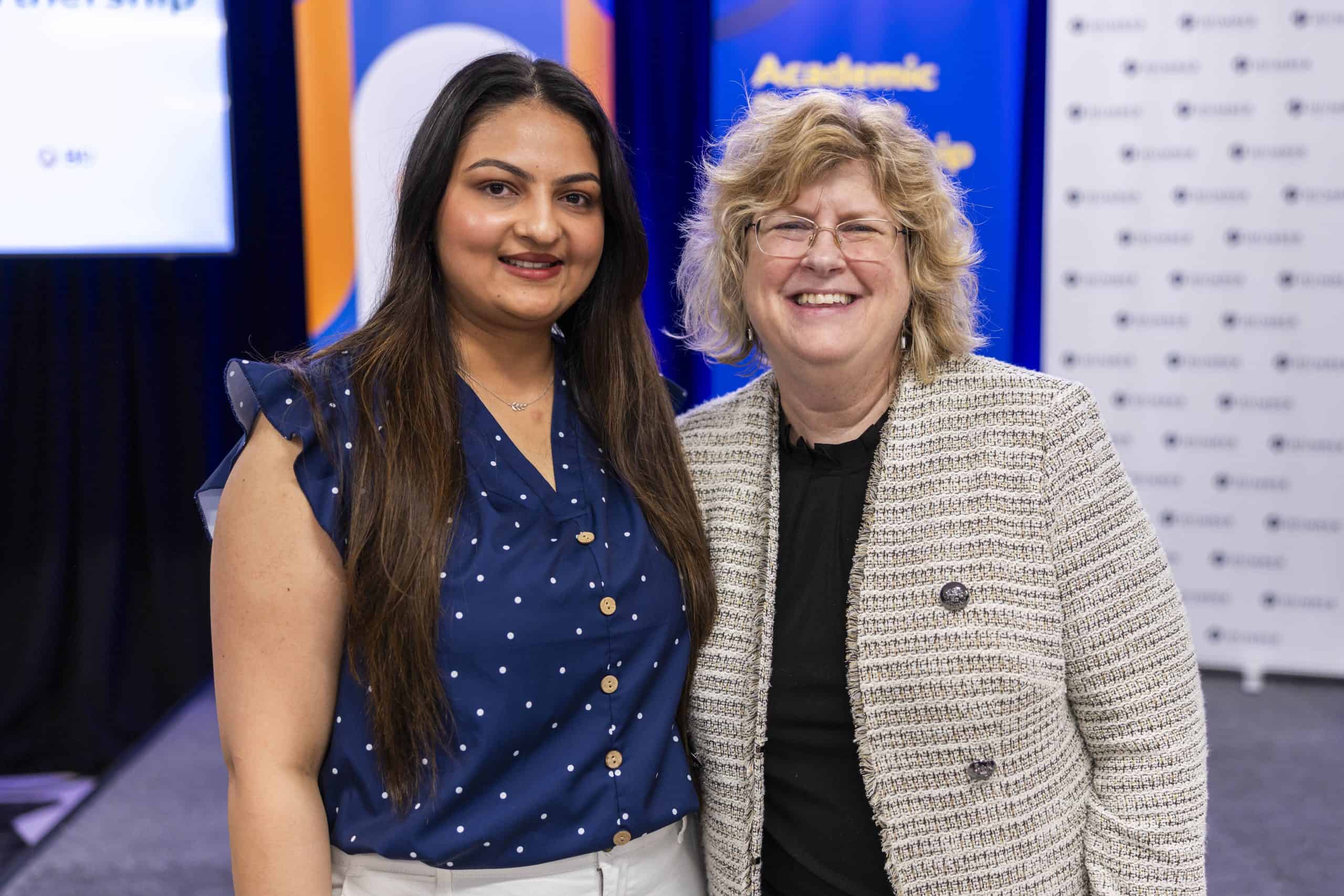
MLA student Mahi Patel, left, and Dr. Ann Marie Vaughan, president and CEO, Humber Polytechnic
Kristan Lingard, senior dean of the Faculty of Health and Life Sciences at Humber, says the program will ultimately increase not just capacity but overall quality.
“I think quality is what we’re all looking for, right? Quality, speed and accuracy. So we’re working on a culture of continuous improvement, continuous innovation, and continuous learning. Those are some of the tangible benefits that we have to achieve for patients.”
Lingard says the demand for more medical lab technicians and assistants is indeed pronounced, with the province asking Humber to increase the number of student spots.
“We just launched the program in the fall and the program filled up, and then we were asked to add capacity. The provincial government actually reached out to us and asked us to add capacity, and so we added a winter intake for medical labs as well and that was a double-size intake. We are seeing interest in the program and filling up the program. The number of applications is very, very high,” she tells INsauga.com.
In fall 2026, Lingard expects the programs to have spots for 40 prospective MLTs and 40 aspiring MLAs.
The new graduates will ideally help rectify a long-standing clinician shortage highlighted in a 2022 report by the MLPAO. The organization said that Ontario conducts about 280 million lab tests a year, but job vacancies remain high, despite improving in the past two years.
In 2022, Statistics Canada’s Job Vacancy and Wage Survey indicated the shortage of MLTs was reaching “crisis levels,” with the need for MLAs also increasing.
“In Toronto, where most MLT jobs in Ontario are located, the time to hire is two to three times longer compared to previous years. On several occasions, staff shortages have also been reported for MLAs. The situation is dire in small towns, rural areas and Northern regions in Ontario,” the report said, adding that when COVID-19 hit in March 2020, 70 per cent of the province’s labs were already short-staffed.
A 2025 survey by the MLPAO found that 68 per cent of Ontario labs continue to experience MLT shortages, while 40 per cent say their shortages are adversely affecting testing turnaround times.
The survey said 44 per cent of respondents said MLT shortages have stayed the same or worsened since last year, and 37 per cent of labs that currently do not take students indicated that they would be able to take students for clinical placements if funding for a trainer (preceptor) was provided.
In 2022, the MLPAO said colleges and universities needed to be made aware of the impending staffing crisis for both occupations, adding that people interested in medicine should know that clinical laboratory science is an in-demand career option.
For Mahi Patel, a student in Humber’s medical laboratory assistant program, this partnership will allow her to seek a career in medicine that’s different from the one she initially envisioned, but is just as rewarding.
“It’s been so good for me to be a part of the Humber education system. We have professors who are still working in hospitals, so they can share their real-time experience as well. And we can also use that experience here at Osler during my placement,” Patel tells INsauga.com.
Patel, who entered the program last fall, will end her academic term this month and begin training at all three Osler facilities.
For her, the best part of the program is learning how to make a diagnosis so a patient can begin the appropriate treatment.
“I love everything about medicine. I love to diagnose. If someone’s having a problem, we can take blood, test them, do chemistry, microbiology, histology, and any other tests, and then we can find out what the person is suffering from,” she says.
After completing the MLA program, she hopes to study to be an MLT.
“If I get a job, I will grab it, and after a few years of experience, I’ll go back to become an MLT. I can learn more things and I can apply those things to my work. Being a hospital health care worker is my dream.”
INsauga's Editorial Standards and PoliciesPollView All
WIN A $100 GIFT CARD
Subscribe to INsauga’s daily email newsletter for a chance to win a $100 Amazon gift card.