
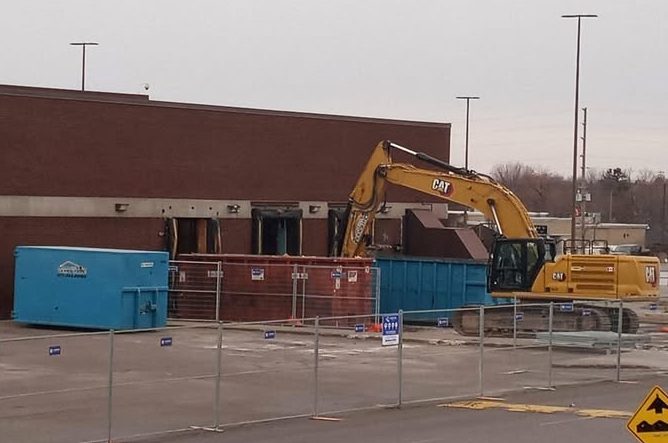
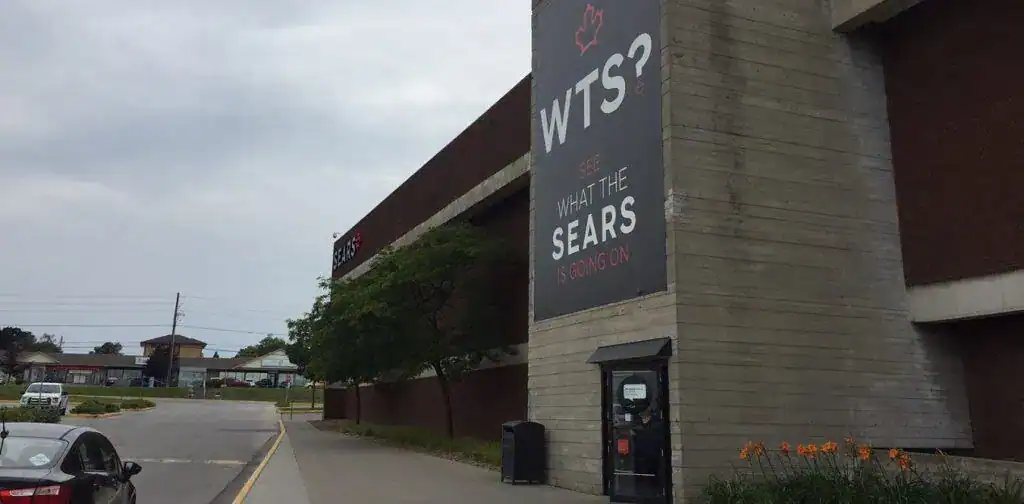
The demolition of the former Sears store at the Oshawa Centre shopping mall has begun, with mall owners Primaris REIT tearing down the one-time anchor to create ‘outparcel’ development.
It is still unknown what that means but it looks like residential will be part of the future after Oshawa Council approved zoning changes around the property this summer to allow for more housing projects with building heights as high as 22 storeys.
Council is hoping to “prioritize” intensification and higher-density mixed-use development in the area to both attract new investment and satisfy the growing need for housing.
Primaris has been preparing for years to regain control of the space – Sears closed all operations in 2018 – as well as the Hudson Bay location on the other side of the mall, with the real estate developer in “active negotiations” for 2-3 large format tenants.
“We have regained control of space that has gone many years without investment, giving us the opportunity to revitalize and dramatically improve the productivity of some of the best located, but recently least productive space in our portfolio,” said Primaris CEO Alex Avery.
Avery also cited nearly 71 acres of land at its mall properties “no longer subject to no-builds,” as well as adjacent land now “more suitable for development.”
The Oshawa Centre lands around the Sears location was not included among the ‘no-build’ changes made – with the value of those lands increasing by $150-$250 million and “substantially” exceeding the entire cost of the redevelopment – but the zoning changes at Oshawa Council certainly qualify as being “more suitable for development,” noted Oshawa Councillor Tito-Dante Marimpietri.

Oshawa Councillor Tito-Dante Marimpietri
“The rezoning speaks to the potential future uses,” Marimpietri said. “The housing market especially that of the multi residential sector is however, in a state of flux and adjustment. This means, while the rezoning allows for such uses, the likelihood in the interim is more inline with a more dynamic commercial retail redevelopment specifically at the old Sears, Bay and LCBO sites, much like what we saw with the Keg and the new food court after Zellers, Cineplex, and Eaton’s were redeveloped into what is currently the new wing of the Oshawa Centre.”
The Sears store sat mostly site sat vacant after 2018 until Suso Skate moved in during the summer of 2024, with the popular pop-up earning a one-year extension in April that was cut short with a termination letter sent last month, telling the company they had to vacate by January 25.
Demolition work began January 13.

Suso Skate
Primaris Chief Operating Officer Patrick Sullivan called the demolition of the Sears location and the vacancy at the Hudson Bay site an “enormous opportunity” for the company.
“It is an incredible time in the retail property landscape to regain control of these spaces, with a strong landlords’ leasing market and no shopping centre development underway.”
As to the Hudson Bay location, Sullivan said there are many international and national tenants “struggling to find expansion space” in Canada, with Primaris in advanced discussions with several “credit-worthy” retailers. “We expect to enter into agreements in the coming months.”
Investor concerns about the changes are unwarranted, he added, noting that mall owners faced similar issues with the closures of Target in 2015 and Sears in 2018. “Department store closures have been a feature of the Canadian retail landscape for decades, including Simpson’s in 1991, Woodward’s in 1993, Woolco in 1994, Kmart in 1998, and Eaton’s in 1999. The era of successful conventional department store anchors in Canada ended long ago, but it has taken many years for these anchors to ultimately exit the retailer landscape. The current chapter is the final chapter in this story.”
During its last 10 years, Hudson Bay was among the historically least productive department store anchors, Primaris declared in a statement, “drawing few consumers, paying very low rent, and holding the most restrictive lease terms among its predecessors.”
While the earlier department store closures released some site restrictions including ‘no builds,’ parking ratios and other tenancy restrictions, those closures failed to liberate control of these sites to landlords, due to the remaining overlapping and redundant site restrictions in the remaining anchor tenant leases.
Canadian malls have evolved substantially over the past 20 years, the company noted, with reduced anchor tenant relevance as tenants have drawn shoppers “out of the department stores and into the corridors of the mall due to their specialized and targeted offering,” with the aggregate sales volume of the mall becoming the ‘anchor.’
Primaris is Canada’s only enclosed shopping centre-focused REIT, with a current portfolio totalling 15.6 million sq. ft., valued at approximately $5.4 billion.
“We’ve been working with planners representing new Oshawa Centre ownership Primaris to reimagine the vacant spaces into more even more community friendly and dynamic new redevelopment opportunities that breath new life into the centre and our city,” Marimpietri said. “Obviously it will take time as process will be done in phases and depends largely on market conditions and the needs of future tenants.”
“On a socioeconomic level, I can say with great optimism that we are really excited by the future outlook of the malls evolution toward higher and better uses for these underutilized spaces.”
PollView All
WIN A $100 GIFT CARD
Subscribe to INsauga’s daily email newsletter for a chance to win a $100 Amazon gift card.