
In today’s world, unpredictability–politically, economically and socially–has become the norm, and since such unpredictability extends to the environment, it can be difficult for Canadians to know how much a bag of coffee beans is going to cost the next time they go shopping.
That said, Canadians who are still reeling from the almost 30 per cent jump in coffee bean prices (felt mostly in retail outlets rather than in big-name restaurants and coffeeshops) that was reported by Statistics Canada last fall can take comfort in the fact that some relief could be in store at the checkout counter.
“It looks like this will be a better year,” Michael von Massow, professor of food agriculture and resource economics at the University of Guelph, tells INsauga.com.
“Brazil looks like it’ll have a better year this year, so that means we could see a short-term decrease in price as yields and supply are better.”
As for why good weather in Brazil means potentially lower coffee prices on Canadian grocery store shelves, it comes down to the oft-mentioned (but currently not top of mind for many) topic of climate change.
“Coffee, very much like cocoa, is the canary in the coal mine of climate change. It’s very susceptible to changes in temperature; it doesn’t like temperatures over 30 degrees,” von Massow says.
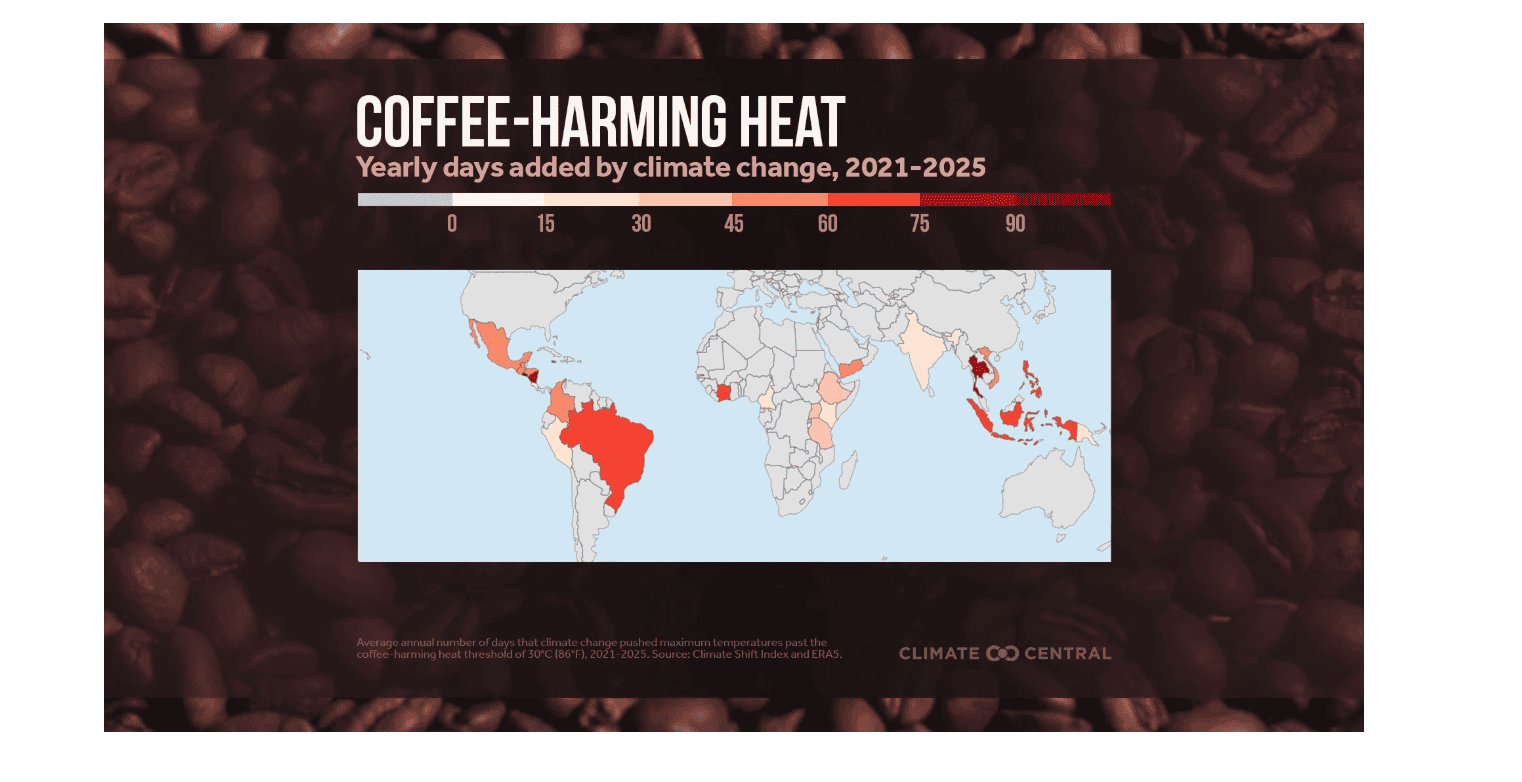
A recent study by the science non-profit Climate Central found that rising temperatures have hindered coffee growth between 2021 and 2025.
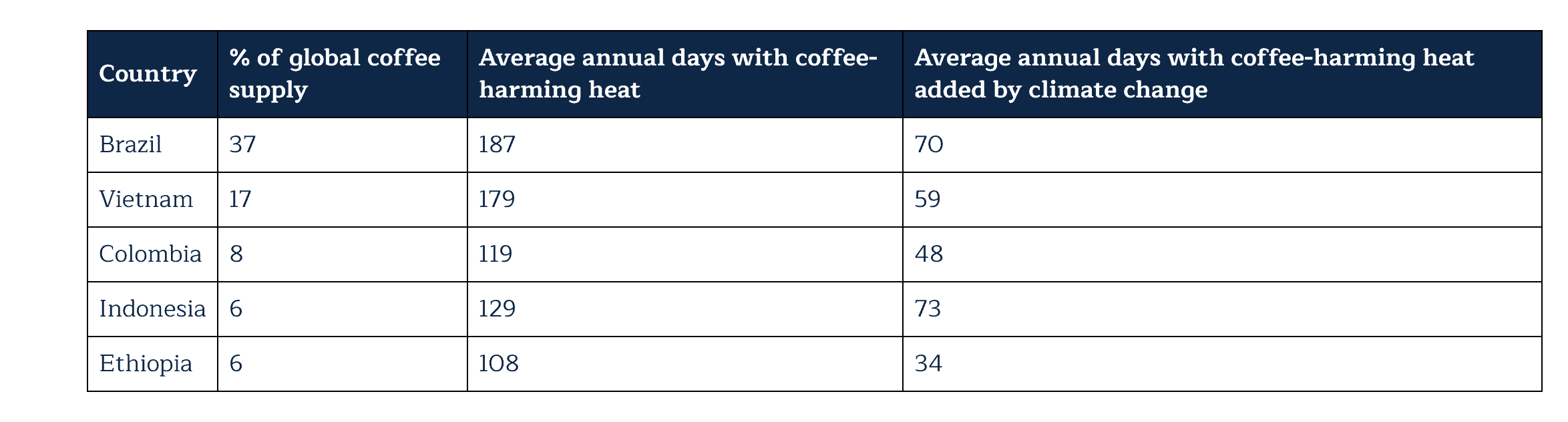
The study found the top five coffee-producing countries — Brazil, Vietnam, Colombia, Ethiopia, and Indonesia — each experienced, on average, 57 extra days of harmful heat per year due to climate change.
The study notes that these countries supply 75 per cent of the world’s coffee, and that Brazil (the world’s top coffee-growing nation) experienced an average of 70 extra-hot days annually. The study said that all 25 coffee-growing countries analyzed, which represent 97 per cent of global production, experienced more coffee-harming heat because of climate change linked to fossil fuel pollution.
The report says some plants are more sensitive to heat than others, with Arabica coffee plants (which account for about 60-70 per cent of the global supply) suffering adverse impacts from temperatures between 25 and 30 degrees.
Robusta beans, on the other hand, are slightly more resilient to moderate heat.
“In the last five years, we’ve seen a few instances in which extreme weather events affect coffee crops and therefore prices,” Kristina Dahl, VP for science at Climate Central, tells INsauga.com.
“Several years ago, we had extreme rainfall that drove prices up to some extent. We know drought can also affect coffee prices and yields.”
Dahl says that while coffee plant growth can be affected by various conditions, coffee pods exposed to high heat can shrivel, reducing the plant’s productivity. With less coffee available–and less quality coffee at that–prices naturally trend upwards.
The upward trajectory of prices in Canada has not gone unnoticed.
According to StatsCan, Canadians paid 27.9 per cent more for coffee at the grocery store year over year in summer 2025. The increase was steeper for roasted or ground coffee (35.2 per cent), with less dramatic impact on instant and other coffee (19.7 per cent).
StatsCan notes that while coffee has generally been more affordable than other grocery staples, prices have risen substantially over the decades, increasing by more than 80 per cent between 1979 and 2024. While price increases were quite significant last year, the largest single-year price increase on record was in 1995, when costs rose 36 per cent.
That said, coffee prices are holding steady at quick-service mainstays such as McDonald’s and Tim Hortons–something von Massow says is not at all surprising.
“One thing you hear a lot is people saying, ‘I buy coffee at Tim Hortons and McDonald’s and I haven’t seen prices go up to the same degree,’ and they’re right. In those instances, those companies absorb some of the cost increase because it’s one of the biggest sellers and if they raise prices, people will stop coming in,” he explains, saying that while small price fluctuations can occur, 30 per cent hikes are not being passed onto consumers.
“Coffee brings people in the door and if they don’t buy coffee, they don’t buy breakfast or a doughnut.”
With Brazil expected to experience more favourable weather in 2026, von Massow believes Canadian consumers will enjoy a little relief at the retail level. Some relief might also be in store for people who operate smaller cafes who have had to absorb some of the higher costs to maintain their customer base.
“They’ve absorbed some of that [price] increase to get people through the door. If no one gets coffee, they lose the entire shop–no one will buy a sandwich or pastry. Last year was very difficult for small places where margins have been squeezed, but they’ll get some relief in the coming year as prices come down a bit, and that should provide some ability to recover some of the margin but not to lower prices,” he says.
Another challenge, which has since been somewhat mitigated, is the ongoing trade war between Canada and the U.S., which began when President Donald Trump levied punitive tariffs against Canadian businesses last year.
“Last summer we saw some tariff impact on coffee prices,” he says, adding that tariffs levied by the U.S. and retaliatory tariffs implemented by Canada also contributed to the uptick in coffee prices.
“We got some relief because the U.S. lowered their tariffs, and we removed ours. Tariffs can have an impact. You can also see changes in demand, but we haven’t seen that substantially in Canada.”
While the weather looks more promising this year, both Dahl and von Massow say coffee growers will have to consider significant changes to ensure their crops remain viable–and those changes could take quite some time to, quite literally, bear fruit.
“There’s been more effort in growing coffee in new regions. We might get to a place where, if places where coffee is grown become too hot, we can say ‘move your crops up the side of the mountain where it’s cooler,’” Dahl says.
“Climate change could open up new areas where coffee could be grown. Twenty-five countries across the tropics produce 90 per cent of the world’s coffee because of their climates. Farmers in California and the Gulf Coast are exploring whether coffee can be grown more locally. It’s not being done to scale, but we could see expansion of coffee [growing] where it’s possible to grow at latitudes where it hasn’t been possible to grow before,” she says.
Dahl also says farmers are experimenting with moving their crops to different areas or with creating more shade, such as by planting avocado trees around coffee plants.
“Mixing shade into coffee growing is important, and it has the side benefit of protecting the soil. Those are easy adaptations that can improve coffee yields,” she says.
That said, adaptation takes time.
“Over time, we’re going to see production move,” von Massow says.
“We’ll see it move up the mountain, places where it was too cool before. It’s going to take time. You have to plant the shrub or tree, and it has to grow, so it’ll take time.”
When asked if the price increases from late last year will remain in place simply because prices tend to go up rather than down, von Massow says that food prices can indeed fall under favourable conditions.
“Prices are sticky down, but some have come down year over year,” he says, adding that Canadians saw lettuce prices decline in January after surging in November of last year.
He also doesn’t think the ongoing war in the Middle East will have much of an impact on coffee prices specifically.
“I don’t expect the war in Iran to have an impact on the price besides transport costs, as fuel costs are going up. [Coffee] is brought aboard ships in large containers and roasted here. There might be some impact on transport costs, but I wouldn’t expect it to be significant. For fresh fruit and vegetables, we’ll see more impact on costs. It needs refrigeration; it comes from further out.”
PollView All
WIN A $100 GIFT CARD
Subscribe to INsauga’s daily email newsletter for a chance to win a $100 Amazon gift card.