
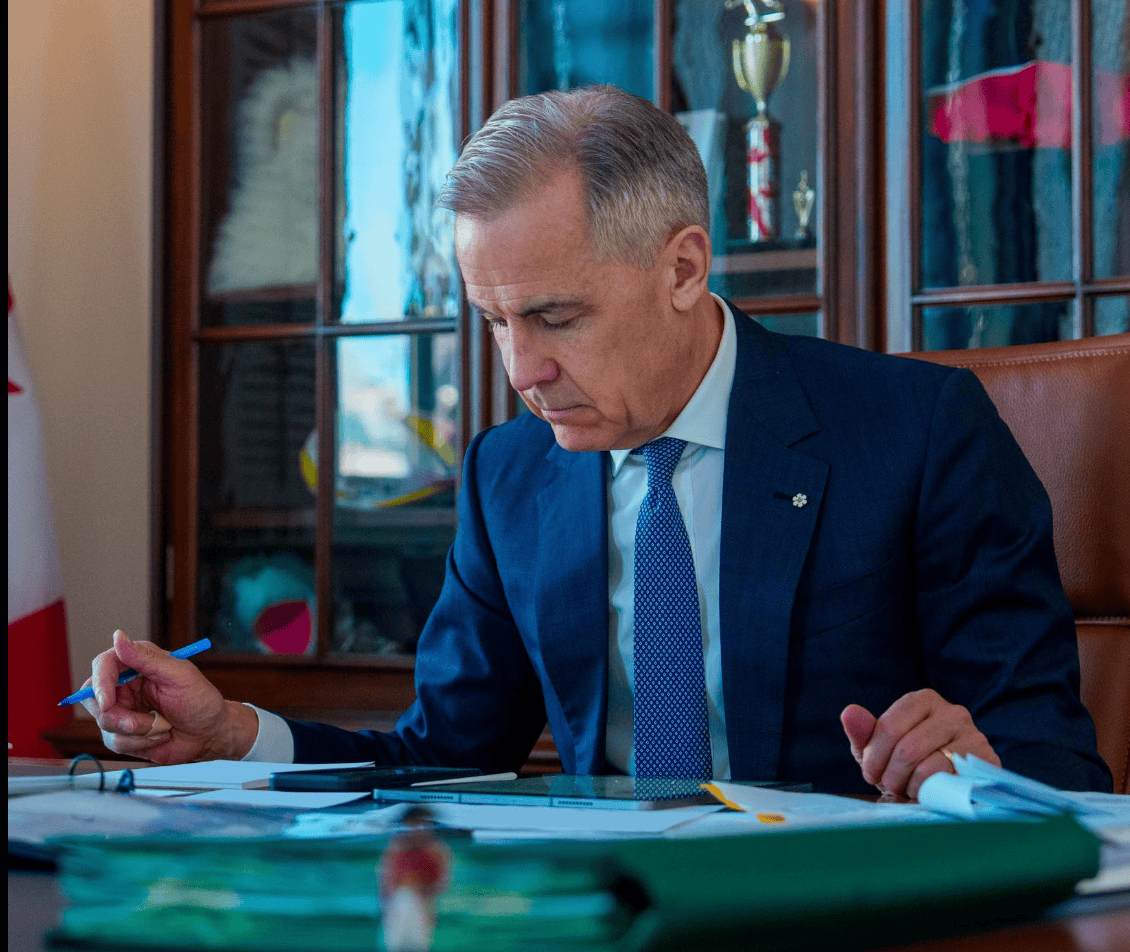
Prime Minister Mark Carney’s noteworthy speech at the World Economic Forum in Davos, Switzerland, has had a profound impact on his–and Canada’s–standing internationally, but the significance of his words is resonating just as much at home.
While not everyone has responded positively to Carney’s assertion that the ‘rules-based order is fading’ at a time when powerful countries (specifically the United States under President Donald Trump) are openly attempting to coerce and control smaller allies, the speech has earned much praise from a domestic audience.
According to an informal online poll conducted by INsauga.com, 64.9 per cent of respondents say they like the prime minister more following his Jan. 20 speech, while 35 per cent say their opinion has not changed.
Over 6,200 votes were cast in the Jan. 30 poll.
The speech came at a time when Carney’s Liberal government, re-elected in April following the resignation of former prime minister and Liberal leader Justin Trudeau, was already polling well with Canadians, many of whom are concerned (to say the least) about persistent threats from south of the border.
Under Trump, the U.S. government has taken an antagonistic approach to allies and Canada in particular, with the president repeatedly threatening to make Canada the “51st state” through economic force and levelling–and threatening to increase–tariffs that have upended the existing CUSMA agreement that guarantees free trade between Canada, the U.S. and Mexico.
“It seems that every day we’re reminded that we live in an era of great power rivalry, that the rules-based order is fading, that the strong can do what they can, and the weak must suffer what they must,” Carney told world leaders at the WEF.
The speech garnered international acclaim and was shared in full by the New York Times and covered by the Washington Post. At home, most local leaders reacted positively to Carney’s call for middle powers to come together to challenge the coercive control exerted by larger military powers.
The speech — which the Prime Minister’s Office said Carney wrote himself — painted a grim picture of a world where global powers increasingly use economic dominance for political coercion and where countries like Canada cannot continue to pretend that the way things used to be is the way they will ever be again.
“What Mr. Carney is saying is also what I’ve been saying for a long time: the world has changed. We need to redesign our economy, we need to diversify our markets, we need to acknowledge that we can’t claim to have an ally to the south,” Quebec Premier François Legault said at a January press conference in Quebec City.
Ontario Premier Doug Ford, who initially took issue with the federal government’s promise to reduce tariffs on Chinese-made EVs in return for reduced tariffs on some agricultural exports, arguing the change would further harm the beleaguered auto industry, also agreed with the thrust of the speech.
“Before Prime Minister Carney even got elected last year, I was out in front of the Canadian people saying, ‘We have to diversify our trade, we have to find new partners around the world, reliable partners,'” Ford told reporters.
Carney never mentioned the United States or President Donald Trump by name, but it was clear that Trump’s tariff-backed global economic shakeup was the target of Carney’s comments about the use of “tariffs as leverage, financial infrastructure as coercion, supply chains as vulnerabilities to be exploited.”
Trump has openly criticized Carney and Canada in the aftermath of the speech, threatening to levy 100 per cent tariffs against all Canadian exports should the country strike “a deal” with China and referring to Carney as “governor” in late-night posts on Truth Social. Trump has also repeatedly lashed out at Canada over its trade negotiations with China since the WEF, making outlandish claims about China “taking over” Canada and potentially banning ice hockey.
During his own speech in Davos, Trump called Carney (and Canada) “ungrateful.”
“But they should be grateful to us. Canada lives because of the United States. Remember that, Mark, the next time you make your statements,” Trump said.
Despite further fallout–Trump has since singled out Bombardier Inc. in a threat to ground and tariff Canadian-made aircraft if Ottawa failed to certify Georgia-based Gulfstream’s G700 and G800 luxury planes last week–other polls show Canadians are largely backing the prime minister.
A recent Ekos poll suggests more than 44 per cent of respondents would vote for the Liberals if an election were held today.
The poll reflects the views of participating readers and is not a scientific sample. Participation was voluntary and limited to the publication’s audience, which generated approximately 15 million pageviews in the 30 days leading up to the publication of this article.
With files from The Canadian Press
Cover photo from Mark Carney’s official Facebook page
PollView All
WIN A $100 GIFT CARD
Subscribe to INsauga’s daily email newsletter for a chance to win a $100 Amazon gift card.