
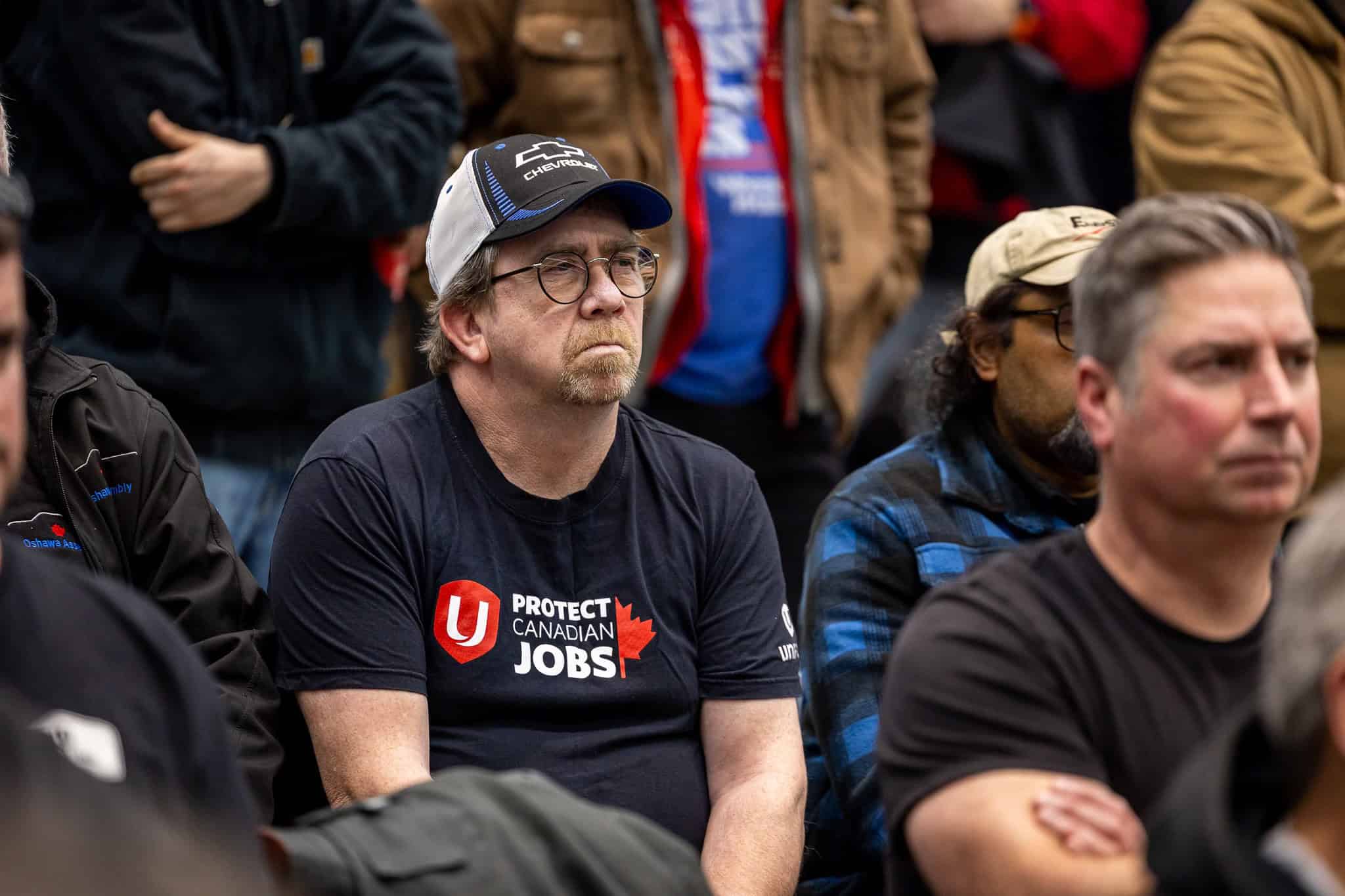
The union representing the county’s automotive sector called Prime Minister Mark Carney’s trade deal with China that will allow up to 49,000 electric vehicles per year into Canada at a reduced tariff rate a “self-inflicted wound to an already injured Canadian auto industry.”
“I don’t want to hear it’s just three per cent of the auto market. It always starts like this. It’s 20 per cent of the EV market,” Unifor President Lana Payne told a crowd of Local 222 members in Oshawa. “The Chinese quota will grow every year. In fact, the government has given them an escalator. There will be no turning back this clock.”
Local 222 members met with Payne Saturday to hear the latest on the trade war and Unifor’s fight to protect Canadian auto jobs, with updates from Payne, Local 222 President Jeff Gray and GM Oshawa Plant Chair Chris Waugh.
The meeting ended with a unanimous vote to send a clear message to Carney and the federal government that union members do not support opening the door to subsidized Chinese EV imports at the expense of Canadian auto jobs.

Unifor President Lana Payne
“Providing a foothold to cheap Chinese EVs, backed by massive state subsidies, overproduction and designed to expand market share through exports, puts Canadian auto jobs at risk while rewarding labour violations and unfair trade practices,” Unifor President Lana Payne told Local 222 members at a rally in Oshawa.
The Chinese tariff deal comes at a time when Canada’s auto sector is already in crisis, hit by U.S. tariffs on Canadian vehicles and rollbacks to U.S. EV policies. More than one-third of Unifor members at Detroit Three facilities are currently laid off, with several plants sitting idle.
Unifor maintains this shift in the auto import landscape is a dangerous move that weakens Canada’s ability to protect Canadian auto jobs during the imminent CUSMA review.
“Finding a resolution to U.S. auto tariffs just got more difficult as Canada has surrendered the leverage of opening our market to China,” said Payne.
Carney, however, says the electric vehicle deal with China is an “opportunity” for Ontario and autoworkers because of “interest” in Chinese companies producing affordable electric vehicles in Canada.
Canada joined the U.S. in putting a 100 per cent tariff on Chinese electric vehicles in 2024, with accusations of unfair subsidies and dumping vehicles in the North American market. The deal struck between Carney and Chinese President Xi Jinping will see Canada allow Chinese electric vehicles into the country at a 6.1 per cent tariff rate.
In return for reducing auto tariffs, China plans to cut its tariff rate on canola seed from 84 per cent to 15 per cent March 1 and drop tariffs on canola meal, lobster, peas, and crabs until at least the end of the year.
Unifor has long warned about the risks of letting Chinese EVs flood the North American market. If left unchecked, Payne said, it would cost Canadian jobs, stall domestic investment and drive more imports from low-cost jurisdictions. “With virtually no Canadian content in Chinese vehicles, our independent auto parts supply chain would also be hard hit.”
The union also said the 49,000 a year number is just the beginning.
“It has already been seen that once access is granted, Chinese automakers quickly grab market share, as in the EU, Brazil, and other countries. Lifting the surtax risks turning Canada into a dumping ground for China-owned companies at the expense of our domestic auto industry and the Canadian workers who rely on it,” Unifor said in a news release.
Payne also had harsh words for the European Union’s decision to suspend a trade deal with the U.S., saying both moves will only “embolden” American President Donald Trump.
“Perhaps not rush to sign a bad trade deal next time – a deal that put the rest of us in a hard spot,” she said.
Ontario Premier Doug Ford joined Payne is slamming the EV agreement with China, with Ford calling it a “lopsided” deal. “This is going to be terrible, for not only just all the people of Ontario, but especially the auto manufacturers, the supply chain,” Ford said Friday.

PollView All
WIN A $100 GIFT CARD
Subscribe to INsauga’s daily email newsletter for a chance to win a $100 Amazon gift card.