
The human element of songwriting, the ‘soul’ of the lyrics and melody of something that is expected to resonate with the humans listening to it, is not going to be replicated by a computerized program any time soon, if ever.
But can artificial intelligence write a hit song?
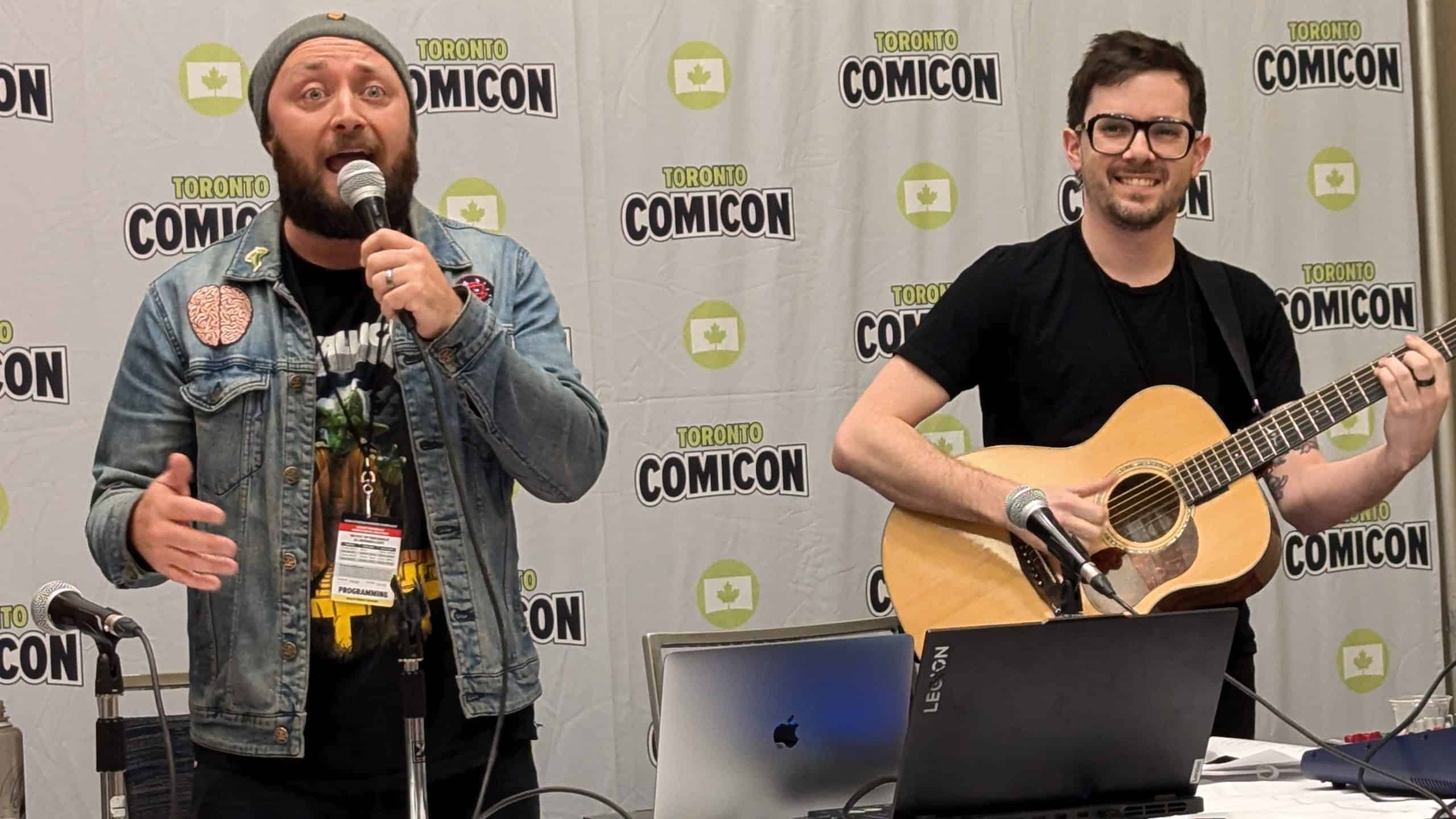
An Ottawa-based ‘nerd rock’ duo who channelled their decade-plus experience as performers – both live and through live streams – have been putting that question to the test at panels and songwriting workshops at fan conventions and college campuses for the past five years.
Ian Nichols and Brock Tinsley of Double Experience, who produced Capital Music Awards-nominated crowdfunded albums in 2020 (Alignment) and last year (Undefeated), brought their live songwriting panel, AI vs Audience: Who Will Write the Superior Song? to Toronto Comicon on the weekend for the “ultimate showdown” of man vs machine.
The premise was simple: Nichols and Tinsley would ask for ideas from the crowd in the room, along with suggestions via their Twitch channel. Themes such as cowboys, emo, strawberries, new frontiers, Shrek and hamburgers were among the suggestions and Tinsley would then quickly construct a melody and Nichols would write some lyrics and five minutes later, they were performing the crowd-sourced song live.
“It’s been a long journey, fighting off loneliness
“It’s low evening, June bug time
Looking for fruits while strawberry visions dance off my weary brow
I know somehow we’re going to make it through
To the last strawberry”
Those same keywords were then fed into an AI simulator, and ChatGPT, with a memory bank of billions of possibilities, produced its own version, which even the band members acknowledged rhymed better.
“Dusty boots on a lonesome trail
Chasing dreams that feel so frail
Memories of us in the summer sun
Laughing hard two hearts in one
But now I’m out here chasing ghosts
The last strawberry, the one I love”
With so many possibilities in the AI memory bank and only a few minutes to craft a song, the odds were stacked against the boys from Double Excperience, but the crowd, albeit made up of humans (many dressed as pop culture characters) and not bots, were unanimous in choosing the human songwriters as their favourite.
Given a bit more time to craft the song, who knows how clever the final product could be, noted Tinsley.
“AI alone cannot replicate people like us,” he said. “The AI robs some of the joy of songwriting.”
But that doesn’t mean artificial intelligence has to be a scary boogie man either, added Nichols, who pointed out plug-ins that songwriters can drop and drag have been used for many years.
“They’re all slightly generative,” he said. “What makes art, art?”
Nichols and Tinsley have been taking their songwriting 101 workshops to comic conventions in Ottawa and Montreal and Toronto’s Fan Expo, as well as to college audiences such as Ottawa’s Algonquin College.
“We’re trying to stir the pot a little bit,” Nichols said with a smile. “In order to save the world from the robotic overlords, we must first examine the creative ground we share.”
That creative ground got a little more complicated in recent years, with lawsuits over copywriting infringements—such as the 2023 ruling that pop star Ed Sheeran did not copy parts of Marvin Gaye’s Let’s Get It On for his own hit, Thinking Out Loud—making the news as songwriters struggle to devise new beats and melodies and stay original in a world that has seemingly heard it all.
Musicians Damien Riehl and Noah Rubin even developed an algorithm just before the pandemic that generated 471 billion melodies to address concerns about copyright lawsuits in the music industry, particularly those related to ‘subconscious copying.’
They then released the melodies into the public domain to try and prevent future copyright disputes.
“Me and you and ChatGPT can write and write but they are just words,” Nichols said. “AI can’t understand our intentions.”
Words in a song also have rhythms inside and that’s why songs are organized in verses, choruses and bridges, Tinsley added.
“We can all still make music that make people move, make people feel. This is just another step in the journey.”
Double Exposure have played shows in 18 countries over the years as they try and connect with their “kin of misfits,” channeling their experiences into a series of livestreams for their followers on Twitch and other platforms.
With their habit of crowdsourcing ideas for songs, developing the songwriting workshops was the logical next step in seeing how AI can help – but not replace – the human element in songwriting.
AI is “just another tool” to be used in the process, Nichols explained.
“We can look at this as saying we are at the precipice of the golden age of songwriting.”
PollView All
WIN A $100 GIFT CARD
Subscribe to INsauga’s daily email newsletter for a chance to win a $100 Amazon gift card.