

In seeking to ensure traffic moves more smoothly along the QEW in Mississauga in the future, work crews restoring the original bridge over the Credit River — and building a new twin bridge steps to the north — have unexpectedly dug up a piece of the city’s past.
The discovery of a number of Indigenous artifacts was made during construction in the latter part of 2024, officials overseeing the QEW/Credit River Improvement Project said this week.
In their latest project update, they noted the artifacts were discovered in the area of the QEW lanes on the original bridge, at the eastern edge of the work site.
“Due to the discovery, some works at this area have paused as archeological investigations continue and project construction in this area is delayed,” project officials said, adding work to reinstall a noise wall, complete a pedestrian bridge over the QEW and work on underground stormwater infrastructure are on hold and “will start at a future date.”
Arrowheads and pottery pieces found
Ontario Ministry of Transportation spokesperson Tanya Blazina said the Indigenous artifacts were found adjacent to the new Credit River bridge during construction “and include projectile points (arrowheads) and ceramic (pottery) sherds.”
She added in an email to INsauga.com the work is being supervised by the ministry and a professional archeologist has been contracted to manage the site investigation and is responsible for preserving the artifacts.
“Professional archeologists and support staff are conducting investigations,” Blazina said. “Indigenous Community Field Liaisons have monitored all archeological investigations throughout the project and we continue to work closely with our Indigenous partners on the QEW Credit River Bridge project.”
The ministry official noted the excavation work is also “being conducted in accordance with the Ministry of Citizenship and Multiculturism standards and guidelines.”
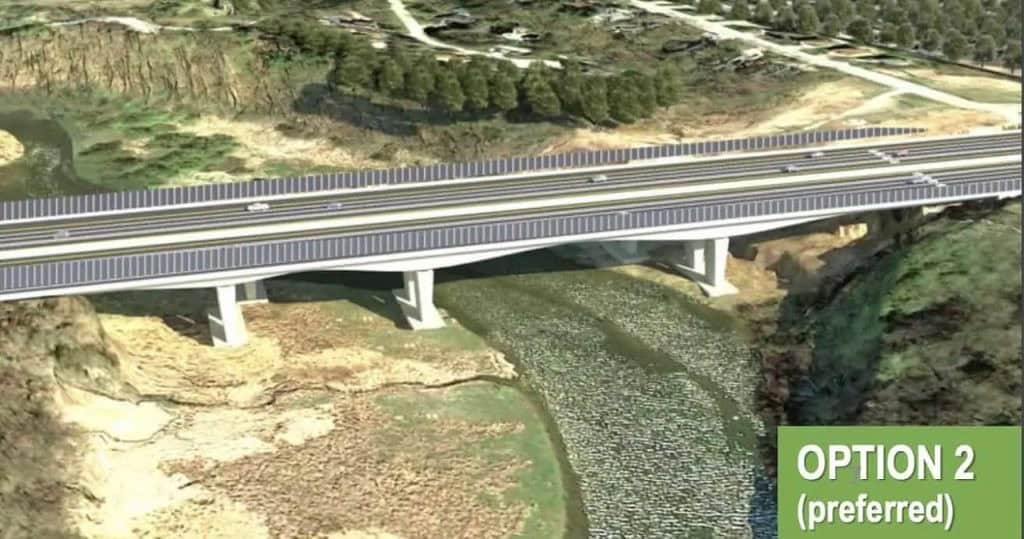
Rendering of a completed twin bridge on the QEW above the Credit River in Mississauga. (Photo: QEW/Credit River Improvement Project)
Blazina didn’t say how long the archeological work is expected to continue, but added the paused work on the bridge will resume following excavation of the site.
The transportation ministry and Infrastructure Ontario head up the QEW/Credit River Improvement Project, which carries a price tag of $313.8 million (at last estimate) and is being completed by EllisDon Corp. and Coco Paving Inc.
They were awarded the contract in late 2020 and work began the following year. No specific completion date has been provided.
Blazina said the major project includes building a new twin bridge to the immediate north of the existing/original Credit River bridge, rehabilitating the original bridge and widening/improving the QEW, among other work.
Pedestrian bridge will be built over the QEW
Project leaders said in their recent update the original Credit River bridge on the QEW has now been rehabilitated and restored as part of the massive undertaking.
Other ongoing work on the multi-year project includes:
- major landscaping along the south side of the QEW, Credit River bridge and east-west pedestrian/cyclist crossing over the river
- additional planting and landscaping of the stormwater ponds at Mississauga Road and the interchange, and Premium Way
- construction of the multi-use trail along Mississauga Road and Premium Way
- construction of the east-west pedestrian/cycling crossing over the Credit River
- ramp to access the north-south pedestrian/cyclist crossing at Premium Way has been built, but work on the middle span and ramp at Pinetree Way has just gotten underway
In addition, the pedestrian bridge over the QEW (at Stavebank Road), currently on hold due to the archeological dig, is expected to be a much-used feature of the improvements when completed.
The project was first studied by Ontario’s Ministry of Transportation in 2013 and initially called for demolition of the original 840-ft.-long Credit River bridge, which was built in 1934 and expanded in 1960.
However, public outcry and strong opposition from Mississauga city council in late 2019 changed the provincial government’s mind and it was decided the existing span, located just east of Mississauga Road, would instead be rehabilitated.
The province said earlier that based on the feedback it received in the aftermath of the initial demolition announcement, it made the decision to preserve the original heritage structure of the bridge, which is owned by the Ontario government.
INsauga's Editorial Standards and PoliciesPollView All
WIN A $100 GIFT CARD
Subscribe to INsauga’s daily email newsletter for a chance to win a $100 Amazon gift card.