

The U.S. trade war has dominated headlines but over half of Canadians say housing policies will influence their vote.
The federal election is less than a week away, on April 28, and while many voters are focused on economic uncertainty, housing is also a major concern.
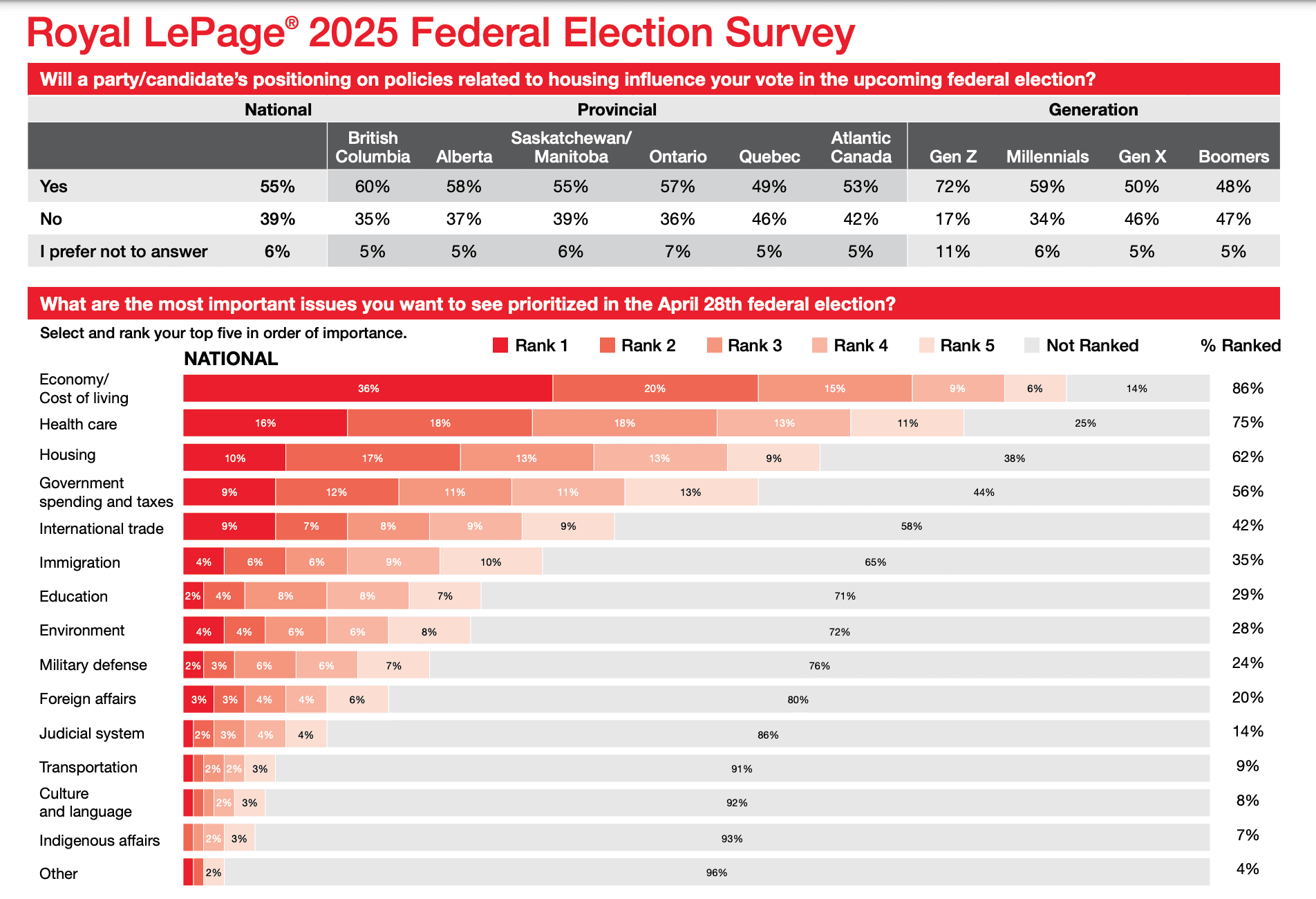
Nationally, 55 per cent of Canadians say a party or candidate’s positioning on policies related to housing will influence their vote in the upcoming federal election, a Royal LePage survey conducted by Burson has found.
Another 39 per cent say housing issues will not influence their vote.
When broken out by age, younger Canadians are more likely to be focused on housing.
Seventy-two per cent of generation Z respondents (aged 18-28) and 59 per cent of millennials (aged 29-44) say that a party or candidate’s positioning on housing will have an impact on their vote, higher than those in generation X (50 per cent of those aged 45-60) and baby boomers (48 per cent of those aged 61-87).
“While much of the discussion has been centred on navigating the rough waters of the U.S. trade conflict, housing affordability has re-emerged as a major priority this election cycle,” said Phil Soper, president and CEO, Royal LePage.
In the last 20 years, home prices have shot up across Canada with numbers coming down in the last year.
Soper suggests Canada’s chronic supply shortage is to blame for high prices. Experts suggest increased demand from investors, population growth and low interest rates are factors in the shortage.
“Despite recent market shifts – including lower interest rates and increased inventory – many young voters recognize that these changes alone are not enough,” he said. “They are seeking real, lasting solutions that can turn the dream of home ownership into a reality.”
When asked to identify the most important issues they want to see prioritized in the April 28 federal election, 86 per cent of respondents selected the economy and cost of living as one of their top five priorities; more than a third (36 per cent) selected it as their most important priority.
Other top priorities include health care (75 per cent), housing (62 per cent), government spending and taxes (56 per cent), international trade (42 per cent) and immigration (35 per cent). Respondents selected and ranked their top five priorities.
Overall, housing ranks as the third most important election priority among Canadian voters, after the economy and health care.
“For young Canadians in particular, there is a clear demand for a leader who can support their goal of achieving home ownership,” said Soper. “The next federal government must follow through on its promises and act decisively to ensure that more housing gets built – quickly and at scale. Real progress will require bold, coordinated action and long-term planning from all levels of government.”
Here are some of the housing promises from five federal parties:
Liberal Party
- double the pace of residential construction over the next decade
- provide low-cost financing options to developers focused on building affordable housing
- encourage the use of a prefabrication Housing Design Catalogue to speed up construction timelines
- reduce costs and eliminate the GST for first-time homebuyers on properties valued up to $1 million
Conservative Party
- build 2.3 million homes over the next five years
- cut development taxes and incentivize municipalities to build more homes
- convert at least 15 per cent of federal buildings into residential units, repurposing underused government properties to ease housing shortages.
- defer the capital gains tax for individuals who reinvest profits into Canadian businesses
- eliminate the GST on all new rental housing and home sales priced up to $1.3 million
The New Democratic Party (NDP)
- double Canada’s current rate of homebuilding with a focus on public investment
- offer first-time homebuyers long-term, low-interest, government-backed mortgages in an effort to lower the barrier to entry
- ban on corporate purchases of affordable rental housing, arguing that such acquisitions often lead to rent increases and displacement
- ensure housing remains accessible to low- and middle-income Canadians
The Bloc Québécois
- unconditional transfer of federal housing funds to the province of Quebec.
- crack down on real estate flipping, offer direct federal financial assistance for first-time buyers’ down payments
- eliminate the GST on certain professional services related to a home purchase
- support housing initiatives for students and seniors
- increased federal funding to address homelessness
The Green Party
- stricter regulations to prevent corporate exploitation of the housing market, such as stopping corporations from buying single-family homes and eliminating tax advantages for Real Estate Investment Trusts
- launch the largest public housing construction program since the 1970s, using Canadian materials and labour, and ensuring publicly-funded homes remain permanently affordable
Learn more about each major political party’s full election platform here: Liberal Party, Conservative Party, New Democratic Party, Bloc Québécois, Green Party.
Lead photo: Digital Maples
INsauga's Editorial Standards and PoliciesPollView All
WIN A $100 GIFT CARD
Subscribe to INsauga’s daily email newsletter for a chance to win a $100 Amazon gift card.